
Most engineers meet their first system design interview with no relevant experience. That is normal. Coding interviews test something you do every day. System design interviews ask you to architect a system you have never built, at a scale you have never operated, in 45 minutes, out loud, in front of a stranger.
This guide is for that engineer: the one who has a system design round scheduled and does not yet know where to start. It moves in five steps, from vocabulary through mock practice. It assumes no distributed systems background.
What actually happens in the interview
The format is consistent across most companies.
An interviewer states a deliberately vague problem. "Design Twitter." "Design a URL shortener." "Design a ride-hailing service." There is no complete specification, and that is intentional. You are expected to ask questions to narrow it down, propose a structure, defend your choices, and adapt when the interviewer changes a requirement partway through.
You will usually have 35 to 45 minutes of actual design time, a shared drawing surface, and an interviewer who says less than you expect.
What they are scoring is not the diagram. It is whether you can take an ambiguous problem, impose structure on it, make reasonable decisions, and explain why those decisions are reasonable rather than merely stating them. A candidate who produces a simpler design and defends it well usually scores above one who draws more boxes and cannot explain any of them.
Why it feels harder than a coding interview
Three reasons worth naming early, because recognizing them removes some of the anxiety.
There is no correct answer. Coding problems have a passing test suite. Design problems have trade-offs. This is disorienting the first time, and it is why memorizing solutions fails.
The scope is unbounded. You could talk about any design for three hours. Part of what is being tested is deciding what matters in the time available.
Silence is penalized. Thinking quietly is fine in a coding round. In a design round, an interviewer who cannot hear your reasoning has nothing to score.
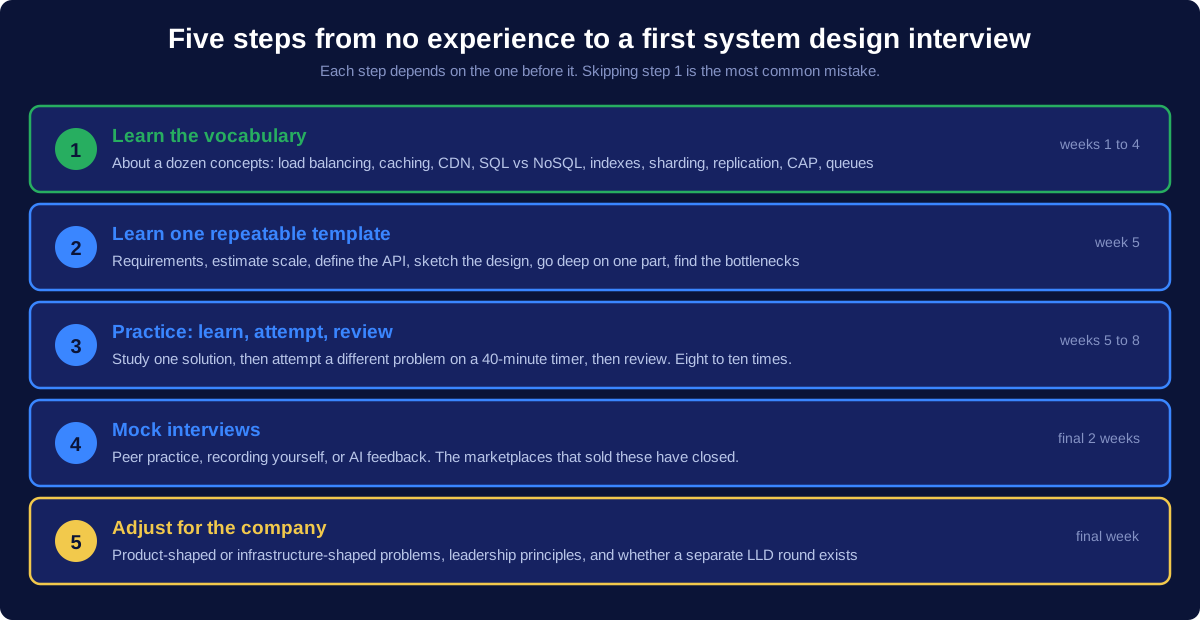
Step 1: Learn the vocabulary before anything else
This is where beginners get stuck, and where most preparation advice skips ahead too quickly. You cannot run a design conversation using words you do not have. Frameworks and practice problems are useless until the vocabulary is in place.
Roughly a dozen concepts carry most first interviews. Each links to a free lesson.
| Concept | What it is | Why it comes up |
|---|---|---|
| Functional vs non-functional requirements | What the system does, against how well it must do it | The first five minutes of every interview |
| Back-of-the-envelope estimation | Rough maths on traffic, storage, and bandwidth | Decides whether your design needs one machine or a thousand |
| Scalability | Handling growth by adding capacity | The underlying subject of the whole round |
| Load balancing | Spreading requests across servers | Appears in essentially every design |
| Caching | Keeping hot data close to the reader | The first answer to "why is this fast?" |
| CDN | Serving content from locations near users | Any design involving images, video, or static files |
| SQL vs NoSQL | Two database families with different guarantees | You will be asked to choose, and to justify it |
| Indexes | Structures that make reads fast | The follow-up to "how do you query that?" |
| Sharding | Splitting data across machines | The moment one database is no longer enough |
| Replication | Keeping copies of data on several machines | How reads scale, and how failure is survived |
| CAP theorem | The consistency and availability trade-off under failure | The classic senior follow-up |
| Message queues | Buffers that decouple services | The answer to traffic spikes and background work |
How to know when this step is done. Pick any three concepts from the table and explain each out loud in about a minute, including one situation where it is the wrong choice. If the "wrong choice" half is hard, the concept is not learned yet. Interviews are decided on that half.
The mistake to avoid here: collecting definitions without ever using them. Learning that a cache stores frequently accessed data is easy. Knowing what happens when a popular cache key expires and ten thousand requests hit the database at once is the part that gets scored.
Step 2: Learn one repeatable template
Once the vocabulary exists, the next problem is structure. Beginners commonly start drawing boxes within the first minute and then run out of direction at minute fifteen.
A template prevents that. Most work through roughly these stages:
- Clarify requirements. Ask what the system must do and for how many users, and confirm what is out of scope.
- Estimate scale. Rough numbers for traffic, storage, and read-to-write ratio.
- Define the API. The handful of operations the system exposes.
- Sketch the high-level design. Boxes and arrows, kept deliberately simple at first.
- Go deep on one or two components. The interviewer usually picks. Sometimes you should.
- Find the bottlenecks. What breaks first as traffic grows tenfold, and what you would do about it.
The point of a template is not that it produces a good design by itself. It is that it removes the question of what to do next, which frees attention for the actual reasoning.
This site has a longer treatment of that structure, including how to time-box a 45-minute interview and what interviewers score at each stage, in the system design interview guide. That page is the natural next read after this one.
Step 3: Practice with a learn, attempt, review loop
Reading solutions feels productive and teaches very little. The loop that works has three parts, in this order:
Learn. Study one classic problem's solution properly, once. Understand why each component is there.
Attempt. Take a different problem. Set a 40-minute timer. Design it on paper or a whiteboard without looking anything up. This will feel uncomfortable, particularly the first three or four times, and that discomfort is the mechanism working.
Review. Only now read a worked solution to that problem. Note specifically what you missed and, more importantly, what you included that was unnecessary.
Doing this eight to ten times is worth more than reading forty solutions.
A reasonable order to work through, from most to least forgiving: a URL shortener, then a pastebin, then Instagram, then a messaging service, then a news feed, then a ride-hailing service. The first two are small enough to finish inside the time limit while the habit is forming.
Worked versions of several of these are free to read: designing a URL shortener, designing Instagram, and designing Twitter. A broader list of what gets asked, with short answers, is in the top 30 system design interview questions.
The mistake to avoid here: memorizing a specific design. Interviewers vary the problem deliberately. A candidate who memorized "design Twitter" and is asked to design a notification system has nothing to fall back on. A candidate who practiced the method adapts.
Step 4: Do mock interviews, and know that the market for them has changed
The framework only becomes automatic under observation. Practicing alone builds knowledge; practicing in front of someone builds the ability to use it while slightly panicked, which is the actual interview condition.
One thing to know before searching for a service: Hello Interview, which ran the best-known mock interview marketplace in this category, discontinued its mock interview and mentorship programs on 31 May 2026 and refunded unexpired credits. A great deal of preparation advice still recommends booking mocks there. That advice is out of date, and no comparable replacement marketplace has taken its place.
Which leaves three practical options:
Practice with a peer. The most reliable route. Another engineer preparing for the same round is easy to find in engineering communities, and the two of you can alternate. The person acting as interviewer learns nearly as much as the candidate, because scoring someone else exposes what interviewers are actually listening for.
Record yourself. Underrated and free. Set a timer, design a problem out loud to an empty room, and watch it back. Most people discover the same three things: they spent too long on requirements, they went silent while thinking, and they never explained why they chose anything.
Use AI feedback. Several platforms now critique a design attempt before showing a solution. It is not equivalent to a person, but it does catch omissions and it is available at 11pm the night before.
Three to five sessions in the final two weeks is a reasonable target.
Step 5: Adjust for the company
The general preparation above covers most of the work. The last part is worth a few hours because the rounds genuinely differ.
- Amazon weights the leadership principles heavily, and the design round is not exempt. Expect to justify decisions in terms of customer impact and long-term ownership.
- Meta tends toward product-shaped problems, often involving feeds, messaging, or social graphs, with strong emphasis on scale.
- Google leans toward infrastructure depth and will probe the internals of a choice further than most.
- Startups and mid-sized companies frequently ask you to design something close to their own product, which makes reading their engineering blog unusually high value.
- Indian product companies often run a separate low-level design or machine coding round alongside the system design round. That is a different interview requiring different preparation.
Searching for recent interview reports for a specific company is worth an evening. Patterns repeat, and knowing whether a company favors product problems or infrastructure problems changes which practice problems are worth the time.
How long this realistically takes
Time to readiness depends mostly on the starting point rather than on the study method.
| Starting point | Realistic preparation time |
|---|---|
| No backend experience | Learn backend fundamentals first. System design will not land yet |
| Backend experience, no distributed systems exposure | 8 to 12 weeks at an hour a day |
| Works with distributed systems, never interviewed on them | 4 to 6 weeks, mostly on structure and practice |
| Has interviewed before and did poorly | 3 to 4 weeks, concentrated on whatever the feedback identified |
| Interview is next week | Skip steps 1 and 5. Learn the template, do three timed attempts, arrange one mock |
The most common planning error is spending nine tenths of the available time reading and one tenth practicing. The ratio should be closer to even by the halfway point.
Free resources worth using
Preparation does not require buying anything.
- The free system design lesson library. 304 lesson pages covering the concepts above and several worked design problems. No account required.
- The system design interview guide on this site. The framework, time-boxing, and an eight-week plan.
- Hello Interview's public guides. A substantial amount of their system design material is free to read and it is genuinely good. What the platform covers.
- Designing Data-Intensive Applications by Martin Kleppmann. Not interview preparation, and too long to read before a near-term interview, but the best explanation of the underlying concepts if the goal is understanding rather than passing. Chapters 5 and 6 are the two most relevant.
- Engineering blogs from companies that operate at scale, which are where most of this knowledge originally came from.
Paid courses exist, including several from Design Gurus, and an honest review of the main one covers who should and should not buy it. None of them are prerequisites for passing.
Frequently asked questions
Can I pass a system design interview with no experience?
Yes, and most people who pass their first one were in that position. What the round tests is structured reasoning about trade-offs, which is learnable in weeks. It does not test whether you have personally operated a system at scale.
How long does it take to prepare for a system design interview?
Typically 8 to 12 weeks at about an hour a day for someone with backend experience but no distributed systems background, and 4 to 6 weeks for someone who already works with them. Less than two weeks is enough for exposure but usually not for the framework to become automatic.
What should I learn first for system design?
The vocabulary, before any framework or practice problems. Roughly a dozen concepts, including load balancing, caching, databases, sharding, replication, and the CAP theorem, carry most first interviews. The table above links to a free lesson for each.
Do I need to memorize system design solutions?
No, and it actively hurts. Interviewers vary the problem on purpose. Practicing a repeatable method transfers to problems you have not seen; a memorized design does not.
Where can I get mock system design interviews now?
Hello Interview ended its mock interview program on 31 May 2026 and no equivalent marketplace has replaced it. The practical options are practicing with a peer, recording yourself and reviewing it, and AI-based feedback tools. Peer practice is the most effective of the three.
Is system design harder than coding interviews?
Different rather than harder. Coding rounds have correct answers and reward speed. Design rounds are open-ended and reward structure, communication, and judgment about trade-offs. Engineers who prefer well-defined problems usually find design rounds harder at first.
What is the difference between system design and low level design?
System design is the high-level round about scaling a service across machines: load balancers, databases, caching, sharding. Low level design, also called object-oriented design, is about the classes inside one service. Some companies run both as separate rounds. Full explanation.
How many practice problems should I do?
Eight to ten, done properly with a timer and a review afterwards, beats forty read passively. Quality of practice matters far more than volume here.
Where to go next
This guide covers the shape of the preparation. Three natural next steps:
- Work through the free lesson library for the vocabulary in step 1.
- Read the system design interview guide for the framework and the eight-week plan in more detail.
- Use the top 30 system design interview questions as the practice list for step 3.
Related reading
- The system design interview guide. The framework, time-boxing, and what interviewers score.
- Top 30 system design interview questions. The problems that get asked, with short answers.
- System design vs object-oriented design interviews. Which round is which.
- Hello Interview system design. What one of the most-used platforms covers.
- DDIA vs Grokking the System Design Interview. Which to read, and when.
- System design patterns: all 62. The full vocabulary, once the basics are in place.
- Can ChatGPT or Grok Prepare You for a System Design Interview?. Where AI chat helps your preparation and where it misleads you.