
Quick disclosure: I built Grokking the System Design Interview, which means I have an obvious bias when comparing it to other resources. The way I have tried to handle that is by being direct about what Designing Data-Intensive Applications does better than my course, which is a lot, and where each resource is the right fit. If anything reads as unfair to DDIA, push back. The book is a classic and the comparison only works if I treat it like one.
What DDIA is, in one paragraph
Designing Data-Intensive Applications, usually shortened to DDIA, is Martin Kleppmann's textbook on distributed systems and databases. It runs nearly 600 pages and covers storage engines, indexing, transactions, replication, partitioning, consistency models, batch processing, and stream processing. It is widely considered the best technical book written on the subject in the last decade, and that reputation is deserved. It is not an interview preparation resource: it contains no system design problems, no interview framework, and no guidance on structuring an answer inside a 45-minute round. People find it through system design searches because the underlying material overlaps heavily, not because the book was written for the interview.
That distinction is the whole answer to "should I read DDIA for system design," and everything below is the detail.
The short version
These two resources solve different problems. Pick based on what you are actually trying to do.
- If you are preparing for a system design interview, take Grokking the System Design Interview. DDIA is the wrong tool for time-bounded interview preparation, however good it is.
- If you want to deeply understand how distributed systems work, read DDIA. The depth on databases, replication, and consistency is unmatched. Then come back to a course to see those concepts applied to specific interview problems.
- If you have time pressure and want some DDIA depth without the whole book, read only Chapters 5 and 6, Replication and Partitioning. They are the two chapters most directly relevant to system design interviews, roughly 80 pages together.
| Grokking the System Design Interview | Designing Data-Intensive Applications | |
|---|---|---|
| What it is | Interview preparation course | Distributed systems textbook |
| Length | 83 lessons, about 20 hours | About 600 pages, 30 to 50 hours of careful reading |
| Interview framework | Six-step framework applied throughout | None, and that is not its goal |
| Worked interview problems | 15 case studies | None |
| Depth on internals | Interview level | Near academic, unmatched |
| Quizzes | 237 | None |
| Updates | Continuous | Fixed at publication |
| Time to value | 2 to 6 weeks | Weeks to months |
| Price | $59 once, lifetime | Roughly $40 to $50 for the book |
| Best for | Passing a system design interview | Understanding distributed systems properly |
What each resource actually is
Designing Data-Intensive Applications
Kleppmann's book reads more like a graduate course than a typical technical book. It makes academic material accessible without simplifying it into uselessness. It is what you would hand to an engineer who wants to genuinely understand how Postgres replication works, or why distributed consensus is hard.
What it does not do is prepare you for an interview. There are no design problems to work through, no method for handling an underspecified question, and no help staying inside a time box. Reading it properly takes weeks.
Grokking the System Design Interview
I created the original course after years of conducting system design interviews and watching strong engineers fail, not because they lacked knowledge but because they lacked structure.
The course is built for interviews. It is organized around a six-step framework you can apply to any system design problem, plus 20 lessons on the building blocks of distributed systems, a dedicated 23-lesson trade-offs chapter, and 15 worked interview problems. It carries 237 quizzes and runs about 20 hours, finishable in 2 to 6 weeks depending on experience. It assumes basic backend knowledge but not distributed systems experience, and it is updated continuously.
For the full structural breakdown, see the curriculum page or the course overview. The honest review covers what works and what does not.
Where DDIA is genuinely better
Three areas where I would recommend DDIA over my own course without hesitation.
1. Depth on database internals and storage engines
DDIA goes far deeper on how databases actually work than my course does, and frankly deeper than any interview preparation resource needs to. If you want to understand B-trees against LSM-trees, how InnoDB differs from Postgres's storage engine, or what happens during a write-ahead log replay, DDIA is where you go.
That depth is not strictly necessary for passing interviews. You can clear FAANG rounds knowing that B-trees favor reads and LSM-trees favor writes without understanding the internals. But the depth changes how you reason about systems, and that reasoning shows up in the harder follow-up questions in senior interviews.
2. Theoretical foundations of distributed systems
DDIA's treatment of consistency models, linearizability, serializability, distributed transactions, and consensus algorithms is at near-academic depth. The consistency chapter in particular is the clearest plain-language explanation of those concepts I have read.
My course covers these topics at the depth needed for interviews, not at the depth needed to truly understand them. For an interview answer, "linearizability means reads always see the latest write" is enough. For building a system that needs linearizability, you need DDIA.
3. The writing itself
Kleppmann writes well. The chapters are tight, the explanations are clear, and the diagrams are among the best technical illustrations in the field. This is a book you will return to over years rather than a resource you finish and forget. That makes it a different kind of investment than a course built for time-bounded preparation.
Where Grokking System Design is genuinely better
I am the wrong person to make this case, but here it is on specifics.
1. Built for interviews rather than for reference
The course teaches you to walk into a 45-minute system design interview with a framework that produces a coherent answer under pressure. The six-step framework, the trade-offs vocabulary, the 15 worked case studies, and the 12 deeper case studies in Volume II all exist to make you better in the actual interview.
2. Time efficiency
DDIA takes 30 to 50 hours to read carefully. The course is about 20 hours of content. For an engineer with a six-week window, the course finishes in time. DDIA does not.
3. Coverage of interview problems specifically
DDIA covers the foundations. The course covers the foundations plus worked solutions to specific interview problems. If your interviewer asks you to design Twitter, the course has walked you through that exact problem. DDIA has not.
4. Continuously updated content
Books freeze at publication. The course is updated continuously, most recently with expanded trade-offs coverage, event-driven and streaming material, and AI study features that let you sketch your own design and get feedback before seeing the solution.
Which to read first, based on your goal
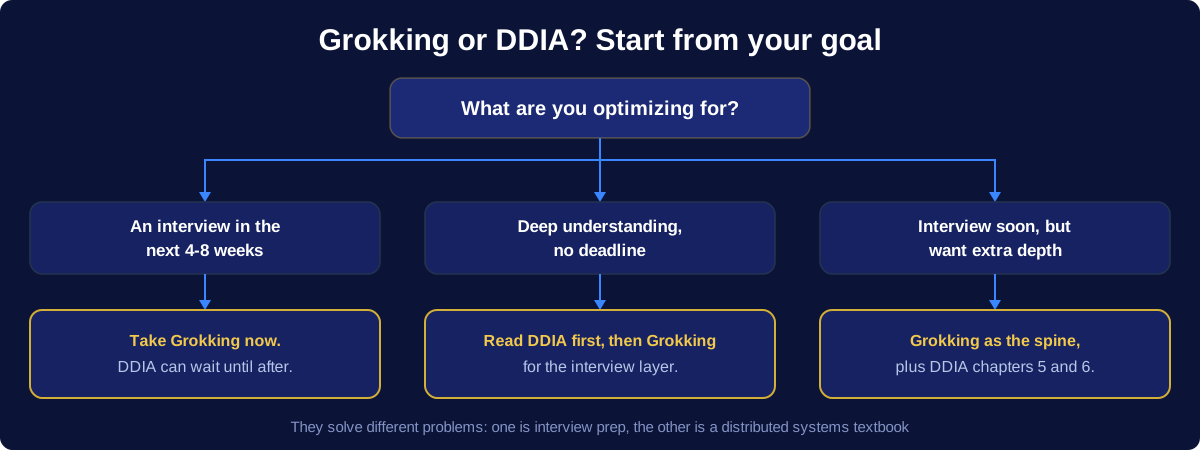
Goal: I have a system design interview in the next 4 to 8 weeks
Take Grokking the System Design Interview. Do not read DDIA. You do not have time, and DDIA does not teach what you specifically need. After your interview, if the topic interests you, come back and read it properly.
If you are a senior or staff engineer, also take Volume II. Its 12 case studies target the deeper problems senior interviews probe.
Goal: I want to genuinely understand distributed systems
Read DDIA first and take your time. It is the foundation that will serve you for years. Afterwards, take the course to see the concepts applied to design problems and to learn the interview framework. The course will feel light in places where you have already gone deep, but the case studies and the trade-offs vocabulary cover ground DDIA does not.
This is the longest path and the most rewarding one for engineers who care about distributed systems beyond passing an interview.
Goal: I have an interview soon but also want some DDIA depth
Take the course as your main preparation and add Chapters 5 and 6 of DDIA as supplementary reading. Those two chapters overlap most directly with interview topics, and reading them will strengthen your understanding of replication strategies, leader election, and partitioning approaches that appear constantly in senior rounds.
Do not try to read all of DDIA in this window. Just those two chapters. The rest can wait.
Goal: I am a senior engineer who already knows distributed systems well
You may not need either resource heavily. Take Volume II for refresher value on the framework and to sharpen your interview communication. Skim DDIA's table of contents and read any chapters where your knowledge feels thin. Most senior engineers find that even with strong production experience, the trade-offs chapter formalizes a few patterns they had only used by instinct.
The two DDIA chapters worth reading even if you skip the rest
Chapter 5, Replication. Covers single-leader, multi-leader, and leaderless replication, with deep treatment of synchronous against asynchronous replication, replication lag, and the consistency problems that follow. This is the best treatment of replication I have read anywhere and it is directly relevant to almost every senior system design interview.
Chapter 6, Partitioning. Covers partitioning by key range against hash, secondary index strategies, rebalancing, and request routing. Deeper and more rigorous than what interview preparation resources provide, and it appears directly in interview problems.
Together these two chapters are roughly 80 pages. A focused engineer reads them in 4 to 6 hours. The investment pays back in stronger reasoning during the parts of system design interviews where replication and partitioning come up, which is most of them.
How to actually combine them
Phase 1, weeks 1 to 4: take Grokking the System Design Interview. Work through the framework, the fundamentals, the trade-offs chapter, and the case studies. Build the structure of how to think about and communicate system design.
Phase 2, weeks 5 to 6: read DDIA chapters 5 and 6. With the framework already internalized, these chapters read as depth additions to concepts you already understand at the surface.
Phase 3, week 7 onward: read DDIA in full if you have ongoing interest. This is the long game. The book is worth absorbing properly even after your interviews are over.
If your time is tight and you only have 4 to 6 weeks, skip Phase 3 entirely and possibly Phase 2 as well. The course alone is sufficient for most interviews. DDIA is the addition for engineers who want depth beyond what interviews require.
Frequently asked questions
What is DDIA?
DDIA is the common abbreviation for Designing Data-Intensive Applications, Martin Kleppmann's textbook on distributed systems and databases. It runs nearly 600 pages and covers storage engines, replication, partitioning, transactions, consistency models, batch processing, and stream processing.
Is DDIA good for system design interviews?
It is excellent background and poor preparation. The concepts it teaches underpin most system design questions, but the book contains no interview framework, no worked design problems, and no guidance on structuring an answer under time pressure. Use it to understand the material, not to prepare for the round.
Should I read DDIA before Grokking the System Design Interview?
It depends on your goal. With an interview in the next 4 to 8 weeks, take the course first and skip DDIA for now. If you want to deeply understand distributed systems and have months to invest, read DDIA first, then take the course to see the concepts applied to interview problems.
Is DDIA enough to pass a system design interview?
Probably not on its own. DDIA teaches the foundations beautifully but does not cover the interview framework, does not walk through design problems with worked solutions, and does not address the communication patterns interviewers score. You can pass after reading it, but you will do better with a resource designed for the task.
Which DDIA chapters are most relevant to system design interviews?
Chapter 5 (Replication) and Chapter 6 (Partitioning). If you are short on time but want some DDIA depth, read those two and skip the rest until after your interview. They are roughly 80 pages combined and take 4 to 6 hours to read carefully.
How long does it take to read DDIA?
Most readers need 30 to 50 hours of focused reading to absorb it properly. Reading the whole book before an interview six weeks away is unrealistic for most people.
Is DDIA outdated?
The foundations it covers, which are replication, consistency, partitioning, and transactions, are largely timeless. Some specific systems and tools have evolved since publication, but the conceptual material remains excellent. Most working distributed systems engineers still consider it the canonical reference.
What if I have already read DDIA but I am not interview ready?
This is common. DDIA gives you the knowledge but not the interview communication skills, the framework, or practiced application to specific problems. Take Grokking the System Design Interview to close that gap. With DDIA already absorbed you will move through it faster and the case studies will land more deeply.
Related reading
- Grokking the System Design Interview vs Alex Xu's books. Comparison with the other most-recommended alternative.
- Grokking the System Design Interview Review. An honest review with a five-question decision framework.
- Hello Interview system design. What the other most-searched platform actually contains.
- The full curriculum. Every lesson with a one-line description.
- The complete interview guide. The six-step framework, time-boxing a 45-minute interview, and an eight-week preparation plan.
Ready to start your interview preparation?
The most reliable next step is the free tier on DesignGurus.io. Spend 30 to 60 minutes with the introductory content to confirm the format works for you. If it does, you can decide whether to upgrade with much better information than any review or comparison post can give you.