
Disclosure before anything else: I built Grokking the System Design Interview, which competes with Hello Interview. That is a real conflict of interest and you should read this page knowing about it. What I have tried to do is describe their product accurately, including the parts where it is better than mine, and keep every number checkable against their own site. If you find something unfair here, it is a mistake rather than a strategy, and I would rather correct it.
People searching for "Hello Interview system design" are usually not looking for a comparison. They are looking for a plain description of what the product is, what is inside it, whether the free material is enough, and what it costs. This page answers those questions first. The comparison comes at the end, and you can skip it.
What Hello Interview is
Hello Interview is a technical interview preparation platform operated by Optick Labs Inc. It was founded by Evan King and Stefan Mai, both formerly senior engineers at Meta and Amazon. It began as a system design resource and has since expanded into other interview types.
The platform now covers five areas:
- System design
- Low-level design and concurrency
- Coding, including AI-assisted coding
- Machine learning system design
- Behavioral interviews
The company states it has served more than 100,000 software engineers and managers.
The teaching format is written guides with diagrams, video walkthroughs on many of the same topics, guided practice exercises, a large interview question library, and an AI tutor that answers questions while you work through a problem.
Hello Interview pricing
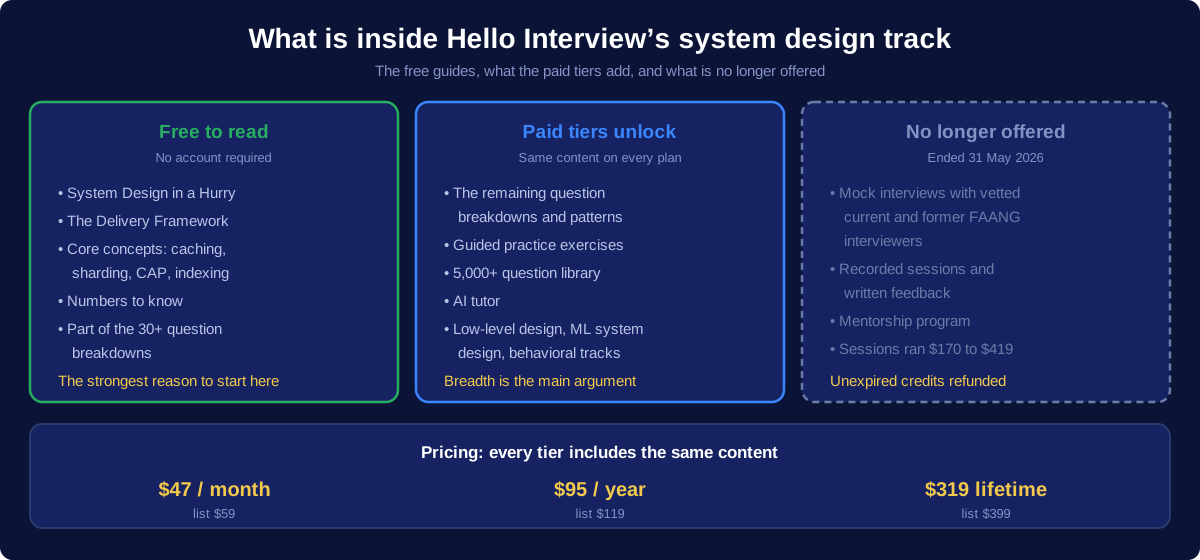
Hello Interview sells Premium access in three plans. Every plan unlocks the same content, so the choice is only about how long you need it.
| Plan | Price | List price | Live Practice interviews |
|---|---|---|---|
| 1 month | $47 | $59 | 1 |
| 1 year | $95 | $119 | 2 |
| Lifetime | $319 | $399 | 4 |
Every plan includes the premium system design, low-level design, coding, AI coding, and behavioral courses, 66 guided practice problems, a library of more than 5,000 candidate-reported interview questions, and the AI tutor. Live Practice is an AI interviewer that runs a full system design interview out loud and returns a hire or no-hire decision with a written report. The lifetime plan adds all future content and never auto-renews, and an annual plan can be upgraded to lifetime later with the remaining time credited.
A month of access for $47 is a low commitment if your interview is soon. A year costs $95. If you interview again in three years, you pay again unless you took the lifetime plan, which is the clearest structural difference from a one-time course purchase. Much of the system design material is also free to read without any plan, as the next section explains.
What the system design material actually contains
The system design track is published as a structured set of guides called System Design in a Hurry. It is the part of the platform most people mean when they search for Hello Interview system design, so it is worth describing in detail.
The structure runs roughly in this order:
Introduction and how to prepare. Orientation material on what a system design interview tests and how to plan study time.
The Delivery Framework. Their named method for running the interview itself: how to move through an underspecified problem in a fixed amount of time without stalling. Every serious system design resource has some version of this. Theirs is compact and clearly written.
Core concepts. Networking essentials, API design, data modeling, caching, sharding, consistent hashing, the CAP theorem, database indexing, and a "numbers to know" page for capacity estimation.
Key technologies. Specific systems you are expected to name in an interview rather than abstract concepts.
Common patterns. Recurring architectural shapes that show up across many problems.
Question breakdowns. More than 30 worked problems, including Bitly, Dropbox, Uber, YouTube, WhatsApp, a rate limiter, and a web crawler. These are the most useful part of the track and the part people link to most often.
Advanced topics. Vector databases, time series databases, and proximity search.
In the Wild. Case studies of how real companies built specific systems, including Shopify and Discord.
There are also company-specific question sets and parallel tracks for low-level design and machine learning system design.
How much of it is free
A substantial portion. Free pages are marked with a checkmark and premium pages with a lock icon. Most of the core concepts material and a meaningful share of the question breakdowns are readable without an account.
I want to be direct about this because it is the single most useful thing to know before you spend money: you can evaluate Hello Interview thoroughly without paying, and you can learn a real amount from it without paying. Very few paid platforms in this category expose that much. It is a genuine strength and I have no interest in downplaying it.
What changed: the mock interviews ended
Hello Interview discontinued its mock interview and mentorship programs on 31 May 2026. Unexpired credits were refunded.
This matters more than any other fact on this page, because for years the mock interview marketplace was the platform's most distinctive feature. You could book a session with a vetted current or former FAANG interviewer, receive a recording, and receive written feedback. Sessions ran roughly $170 to $419.
Many comparison articles still recommend Hello Interview primarily for that feature. An earlier version of my own comparison post did the same. Those recommendations are now wrong.
The founders' stated reasoning was that one-to-one work reaches a limited number of people. The platform has moved toward guided practice and AI-run practice instead. Every Premium plan now includes Live Practice interviews, in which an AI interviewer runs a full system design interview and returns a written report. The pricing page offers no human mock interviews or coaching.
If practice with a human interviewer is central to your preparation plan, you now need to arrange it somewhere else regardless of which platform you buy.
What it does well
Three things I would point to without qualification.
1. The free guides are good and there are a lot of them. The writing is clear, the diagrams are clean, and the question breakdowns follow a consistent structure. If you read nothing but the free pages, you would be better prepared than you were.
2. The breadth for one price. One subscription covers system design, low-level design, concurrency, coding, machine learning system design, and behavioral. If you are preparing for a complete interview loop rather than one round, that is genuine convenience and a real cost advantage over buying separate courses.
3. It is written by people who ran these interviews recently. Both founders came from senior engineering roles at Meta and Amazon. The material reflects how these interviews are actually scored rather than how they are described in general advice.
Where it is weaker
Three honest limits.
1. There is no live human feedback anymore. The AI tutor is useful, and I am not going to pretend AI feedback is worthless, but it is not the same product as a former FAANG interviewer telling you that your requirements clarification took nine minutes and cost you the design. The thing that most distinguished the platform is gone.
2. Depth on trade-offs is spread across the material rather than concentrated. Trade-off reasoning is what senior interviews are decided on: strong versus eventual consistency, SQL versus NoSQL, push versus pull, stateful versus stateless. Hello Interview covers these inside problem walkthroughs and concept pages. That works, but it means you absorb trade-offs incidentally rather than studying them as a subject. Whether that matters depends on your level.
3. It is a library rather than a progression. The material is organized as a set of guides you navigate, not a curriculum that tells you what to do next and when you are finished. Some people prefer this. If you want a defined path with an end point, you will have to impose that structure yourself.
Is the system design material enough on its own?
For a mid-level interview, if you read all of it carefully and practice the question breakdowns actively rather than passively, yes, it can be.
For a senior or staff loop, I think it is thin in one specific place, and I am aware this is exactly where my bias sits, so treat it accordingly. Senior interviews spend most of their time in trade-off discussion and in follow-up questions that probe how a mechanism actually works. Material organized as guides plus worked problems gives you the shapes. It gives you less practice defending a choice against pressure.
The honest test: read three of their free question breakdowns. If you can close the page and argue both sides of every design decision in them, the material is doing its job for you. If you can reproduce the diagram but not defend it, you need something that drills trade-offs directly, from them or from anyone else.
Who it suits
Take Hello Interview if:
- You are preparing for a full interview loop and want coding, behavioral, and system design covered by one purchase.
- You want to spend as little as possible before an interview that is a few weeks away.
- You learn well from written guides and want to read a lot of material before paying for anything.
- You want machine learning system design, low-level design, and coding bundled with system design in one subscription rather than bought separately.
Look elsewhere if:
- You came specifically for mock interviews with a human interviewer. Those ended. The AI Live Practice sessions are useful, but they are not the same thing. Arrange human mocks through peers or a dedicated mock platform.
- System design is the only round you are worried about and you want maximum depth on it specifically.
- You want a structured curriculum with a defined beginning and end rather than a library to navigate.
- You want to pay once and keep access permanently for less than $319.
How it compares to the alternatives
Briefly, since this page is about Hello Interview rather than about the comparison.
| Hello Interview | Grokking the System Design Interview | |
|---|---|---|
| Format | Written guides, video, guided practice, AI tutor | Curriculum: text, video, interactive diagrams |
| Scope | System design, LLD, coding, ML, behavioral | System design, with separate courses per topic |
| System design depth | Core concepts plus 30+ question breakdowns | 83 lessons, 15 worked problems, 23-lesson trade-offs chapter |
| Free material | Large free tier | Introductory lessons and fundamentals |
| Structure | Library you navigate | Progression with a defined path |
| Pricing | $47 month, $95 year, $319 lifetime | $59 once, lifetime |
| Mock interviews | Human mocks ended 31 May 2026; AI Live Practice included | Never offered in-house |
The short version of my own bias: Grokking goes deeper on system design specifically and has a senior-level second volume; Hello Interview covers more interview types for less money up front. Which is right depends on whether your problem is breadth or depth.
For the full head-to-head, see Hello Interview vs Grokking the System Design Interview. For six options compared side by side, including System Design School, ByteByteGo, and Alex Xu's books, see Hello Interview alternatives.
Frequently asked questions
What is Hello Interview?
Hello Interview is a technical interview preparation platform operated by Optick Labs Inc. and founded by Evan King and Stefan Mai, both formerly senior engineers at Meta and Amazon. It covers system design, low-level design and concurrency, coding, machine learning system design, and behavioral interviews, using written guides, video, guided practice, a question library, and an AI tutor. The company states it has served more than 100,000 engineers.
Is Hello Interview's system design material free?
Partly. A substantial portion of the System Design in a Hurry guides is free to read, including much of the core concepts material and a share of the question breakdowns. Premium pages are marked with a lock icon and require a paid plan.
How much does Hello Interview cost?
$47 for one month, $95 for one year, or $319 for lifetime access, against list prices of $59, $119, and $399. All plans include the same courses, guided practice, the question library, the AI tutor, and one to four AI Live Practice interviews. The pricing section has the full table.
Does Hello Interview still offer mock interviews?
Not with human interviewers. Hello Interview discontinued its human mock interview and mentorship programs on 31 May 2026 and refunded unexpired credits. Premium plans now include AI-run Live Practice interviews instead: one with a month of access, two with a year, and four with lifetime. Any article recommending the platform for its human mock interview marketplace is out of date.
What is the Delivery Framework?
It is Hello Interview's named method for structuring a system design interview: how to move through an underspecified problem within the time available without stalling. Most system design resources teach an equivalent method under a different name.
Is Hello Interview good for senior engineers?
It is usable, and the question breakdowns go beyond entry level. The limitation I would flag is that trade-off reasoning, which is what senior loops mostly test, is covered across the material rather than concentrated as a subject. I built a course that concentrates it, so weigh that opinion accordingly.
Is Hello Interview enough on its own for a system design interview?
For a mid-level interview, read carefully and practiced actively, it can be. For a senior loop, most candidates benefit from adding a resource that drills trade-offs and defends design choices under follow-up questions.
Hello Interview or Grokking the System Design Interview?
Hello Interview covers more interview types for less money up front. Grokking goes deeper on system design specifically and has a senior-level Volume II. Pick depth or breadth based on which rounds you are actually worried about. I built Grokking, so read the full comparison rather than taking my summary at face value.
Related reading
- Hello Interview vs ByteByteGo: Which One Fits Your Prep, for the two competitors compared directly
- Hello Interview vs Grokking the System Design Interview. The detailed head-to-head.
- Hello Interview alternatives. Six system design resources compared, including System Design School and ByteByteGo.
- Grokking the System Design Interview vs ByteByteGo. Curriculum against illustrated library.
- Grokking the System Design Interview Review. An honest review of my own course, weaknesses included.
- The complete interview guide. The six-step framework and how to time-box a 45-minute interview.
Read both free tiers before you pay either of us
The most reliable next step costs nothing. Read two or three of Hello Interview's free question breakdowns, then spend half an hour in the free tier on DesignGurus.io. Format preference decides this choice more than any feature comparison, and you can test it without spending money.