
Quick disclosure: I built Grokking the System Design Interview, so I have an obvious bias when comparing it to other resources. The way I've tried to handle that is the same as in every comparison on this site: focus on which engineers each resource genuinely fits, and be specific about where the other one is better. ByteByteGo is an excellent product built by someone I respect. If this post reads like a takedown instead of a comparison, push back.
If you've researched system design prep at all, you've met both of these names. Grokking, the course that defined the pattern-based approach. ByteByteGo, Alex Xu's platform, grown out of the most popular system design books and one of the biggest engineering newsletters in the world.
People keep asking which one to pick, and the honest answer is the same one I gave for Hello Interview: they're built around different ideas of how you learn, and the right choice depends on which idea matches you. One note before we start: if you're specifically comparing the course against Xu's books, that's a separate post. This one is about the ByteByteGo platform.
The TL;DR
- ByteByteGo fits engineers who learn best from visual, animated explainers, want a broad library of bite-sized content they can browse continuously, and already trust Xu's style from the newsletter or YouTube channel.
- Grokking the System Design Interview fits engineers with an interview on the calendar who want a guided path: a framework drilled until it's reflex, a dedicated trade-offs module, worked case studies, a practice loop with quizzes and AI feedback, and a track that extends to senior and staff-level prep.
- The shortest version: ByteByteGo is a content library you browse. Grokking is a curriculum you follow. Libraries are better for continuous learning. Curricula are better for deadlines.
The rest of this post explains where each is genuinely stronger and which engineers should pick which.
What each platform actually is
ByteByteGo
ByteByteGo is Alex Xu's learning platform, built on the success of his System Design Interview books and the ByteByteGo newsletter. Xu is a former engineer at Twitter, Apple, and Zynga, and his real superpower is visual communication: the animated diagrams and one-page visual explainers that made his newsletter and YouTube channel famous are the platform's core format.
The platform is subscription-based and includes digital, interactive versions of the book content plus a large and growing library of visual explainers across system design and adjacent engineering topics. The strength is consistency of style: nearly everything on ByteByteGo is concise, visual, and pleasant to consume. It's helped a lot of engineers genuinely understand systems they'd only pretended to understand before.
Grokking the System Design Interview
I created Grokking the System Design Interview after conducting hundreds of system design interviews and watching strong engineers fail for lack of structure, not lack of knowledge. The course pioneered the pattern-based approach that most modern resources, ByteByteGo included, have since adopted in some form.
The course is 83 lessons across 5 chapters: an introduction to how these interviews are scored, the building blocks of distributed systems, a dedicated 23-lesson trade-offs module, 15 case studies worked end to end with the same 6-step framework, and an appendix of reference templates. The format mixes video, text, interactive diagrams, 237 quizzes, and AI features that critique your own design attempts. It sits at the base of a two-step path that continues through Volume II for senior and staff engineers. Volume II also absorbed the deep dives from the course once sold separately as Grokking the Advanced System Design Interview.
For the full structural breakdown, the curriculum page lists every lesson, and the course overview covers the methodology and history.
Side by side
| Grokking the System Design Interview | ByteByteGo | |
|---|---|---|
| Core format | Guided curriculum: video, text, interactive diagrams | Visual library: animated explainers, interactive book content |
| Organizing idea | A path you follow to a deadline | A library you browse continuously |
| Interview framework | 6-step framework applied across 15 case studies | Framework from the books, per-problem chapters |
| Trade-offs coverage | Dedicated 23-lesson module | Woven into individual explainers |
| Practice loop | 237 quizzes + AI design playground | Primarily consumption-based |
| Seniority path | Volume I → Volume II → Advanced | One content level |
| Breadth beyond interviews | Interview-focused | Wide: newsletter-style engineering topics |
| Pricing model | Lifetime or annual all-course subscription, free tier | Annual subscription |
| Best at | Structured prep under a deadline | Visual understanding, ongoing learning |
Where ByteByteGo is genuinely better
Three areas where I'd point engineers to ByteByteGo without hesitation.
1. Visual explanation quality
Xu's animated diagrams are the best in this space, full stop. If you've watched the YouTube videos, you know the style: a complex flow reduced to a clean animation that makes the mechanism obvious. Our interactive diagrams are strong, but ByteByteGo's visual production is its identity, and for engineers whose understanding clicks through animation rather than text or lecture, that's decisive.
2. Breadth for continuous learning
ByteByteGo long ago outgrew "interview prep." The library covers how real systems and protocols work across a wide range of topics, in a format you can consume in ten-minute sessions indefinitely. If your goal is to become a better-informed engineer over months and years, rather than to pass an interview in six weeks, ByteByteGo's model matches that goal better than any deadline-oriented course does, mine included.
3. A style you may already trust
Millions of engineers know exactly what Xu's content feels like before spending a dollar, because the newsletter and YouTube channel are the product's free tier in practice. If that style already works for you, ByteByteGo is a low-risk purchase. There's real value in knowing what you're getting.
Where Grokking System Design is genuinely better
Four areas where the course is the stronger tool, and they share a theme: they're the parts of preparation that a content library structurally doesn't do.
1. It's a path, not a pile
When your interview is in five weeks, "what do I study today, and in what order" is most of the battle. The course answers that by design: chapters build on each other, case studies apply what the fundamentals taught, and the study plans map it to 2-week and 6-week schedules. Browsing excellent explainers feels productive, but a library can't tell you what you're missing. A curriculum's whole job is knowing that.
2. The trade-offs module
The dedicated 23-lesson trade-offs module remains the single structural advantage readers cite most, especially for senior loops where the interview is one long trade-off conversation. Strong vs eventual consistency, SQL vs NoSQL, stateful vs stateless, token bucket vs leaky bucket, each drilled as a decision skill with its own lesson. ByteByteGo covers trade-offs the way most resources do, inside topic explainers. We treat them as the curriculum's spine.
3. The practice loop
Understanding a system when Xu animates it and producing a design under questioning are different skills. The course is built around the second: attempt the case study before seeing the solution, get your attempt critiqued by the AI design playground against the patterns the course teaches, then take the quiz that locks it in. 237 quizzes run through the course. Consumption-first platforms don't force this loop, and the loop is where interview performance actually comes from.
4. A track that scales with seniority
Volume II adds 12 deeper case studies for L5+ loops, and Advanced continues into principal-level architecture. ByteByteGo is one body of content at roughly one level. If you're a senior or staff engineer, the ceiling matters: the honest review is explicit that Volume I alone caps at mid-level difficulty, and the tiered path is the answer we built for that.
Which fits which engineer
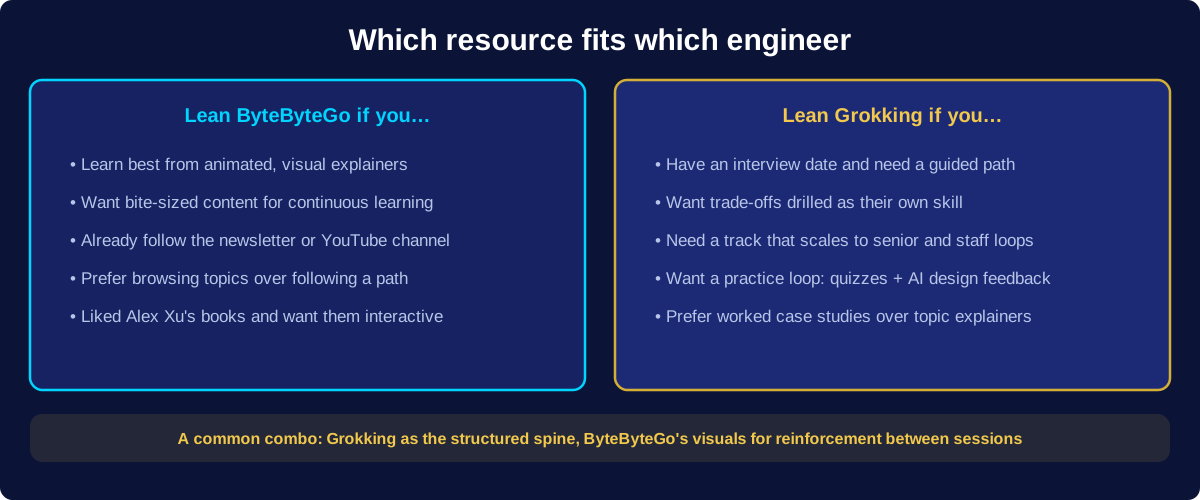
You have an interview in 2 to 8 weeks. Grokking, and this isn't close. Deadline prep needs sequence, worked problems, and a practice loop. Use ByteByteGo's videos as reinforcement when a concept needs another angle.
You're learning system design with no deadline. Either works, and honestly ByteByteGo's browse-anytime model may fit a no-deadline life better. If you want durable interview readiness to eventually come out of it, the course's structure still pays; the 6-week thorough plan was built for exactly this reader.
You're a senior or staff engineer targeting L5+ loops. Grokking's tiered path is the more direct fit, for the same reason I gave in the Hello Interview comparison: senior prep needs depth that scales, and Volume II plus the trade-offs module is built for that bar.
You're a visual learner who bounces off text. ByteByteGo first, genuinely. The course has video and interactive diagrams throughout, but its text-and-video DNA still shows. If animation is how understanding happens for you, start where the animation is best, and consider adding the course's case-study practice loop before the actual interview.
You loved the books and want more. ByteByteGo is the natural continuation of the books' style. If what you want instead is to convert book knowledge into interview performance, that's the gap the course's framework and practice loop fill, which is the same conclusion as the books comparison.
Can you use both?
Yes, and the combination is coherent because they're strong at different layers.
Grokking as the spine, ByteByteGo for reinforcement. Follow the course's sequence and practice loop. When a concept needs a second explanation, watch the ByteByteGo treatment of it; a two-minute animation is a great way to unstick a mental model between study sessions. This is the combination I'd recommend for anyone with an interview date.
ByteByteGo as your ongoing diet, Grokking when an interview appears. Plenty of engineers read the newsletter for years and then hit a FAANG loop. Your conceptual base will be strong; what you'll be missing is the framework, the time-boxed structure, and live-fire practice. A focused pass through the course (framework, trade-offs module, 8-10 case studies) converts that base into interview performance in a few weeks.
What I wouldn't do is subscribe to both simultaneously as parallel primary resources. The conceptual overlap is large, and doubled consumption crowds out the practice time that actually moves your interview outcome.
A note on pricing models
The models differ more than the prices. ByteByteGo is an annual subscription: good economics if you'll use the library continuously, wasteful if you needed it for one prep cycle and forgot to cancel. Grokking offers both patterns: an annual subscription that unlocks all Design Gurus courses (the right choice for one interview cycle), and lifetime access for people who want to own the course and its updates permanently. There's also a free tier, including the AI features, so you can evaluate the format before paying anything. Check both sites for current prices; I'm deliberately not quoting numbers that will be stale in six months.
Frequently Asked Questions
Is ByteByteGo or Grokking the System Design Interview better?
Neither is universally better. ByteByteGo is the stronger visual library for continuous learning; Grokking is the stronger structured curriculum for deadline-driven interview prep, with a dedicated trade-offs module, a quiz-and-AI practice loop, and a path that extends to senior-level material. Pick based on whether you're browsing or preparing.
Is ByteByteGo the same as Alex Xu's books?
The platform includes interactive versions of the book content plus a much larger library of visual explainers and newsletter-style topics. If you're weighing the course against the books specifically, see our books comparison.
Is ByteByteGo enough to pass a system design interview?
It can carry the knowledge layer well. What it doesn't enforce is the interview layer: a repeatable framework, time-boxed structure, and practice producing designs rather than consuming explanations. Engineers who prep on consumption alone tend to have strong vocabulary and shaky structure. Whatever resource you use, add attempted case studies and live mock interviews.
Which is better for senior engineers?
Grokking, primarily because the tiered path from Volume I to Volume II is built to scale past mid-level difficulty, and senior loops turn on the trade-off conversations the 23-lesson module drills. ByteByteGo's content is excellent but sits at roughly one level.
Can I use ByteByteGo and Grokking together?
Yes. The combination that works: the course as your structured spine and practice loop, ByteByteGo's animations as reinforcement when a concept needs a second angle. Running both as parallel primary subscriptions mostly buys you overlap.
Does Grokking have video like ByteByteGo?
Yes. The current course pairs video walkthroughs and interactive diagrams with the written lessons across all case studies and fundamentals. ByteByteGo's animation style is its specialty, though; if pure animated explainers are your requirement, it wins that dimension. The update rundown covers what the course's format looks like now.
Related reading
- Hello Interview vs ByteByteGo: Which One Fits Your Prep, for the two competitors compared directly
- Grokking the System Design Interview vs Alex Xu Books. The books specifically, rather than the platform.
- Grokking the System Design Interview vs Hello Interview. The same which-fits-which treatment for the other major platform.
- Grokking the System Design Interview Review: Is It Worth It?. The honest founder review, including who shouldn't buy.
- How Long Does It Take to Finish Grokking the System Design Interview?. The 2-week and 6-week plans referenced above.
- The Full Curriculum. Every lesson, free to browse, so you can compare coverage directly.
Compare them yourself, free
Both products let you evaluate before paying: ByteByteGo through the newsletter and YouTube channel, Grokking through the free tier, which includes the introductory lessons and the AI design playground. Spend 30 minutes with each format. Which one you keep coming back to is the real answer to this post's question.