
A quick disclosure: I created this course, so I have an obvious bias when I talk about how long it takes. The numbers in this post reflect what I actually see across our learner base, including the people who finish faster than expected and the people who take much longer. If anything reads as marketing-friendly fiction, push back.
The shortest honest answer is: anywhere from one week to three months, depending entirely on you.
That answer isn't useful by itself. The rest of this post breaks down what determines where you fall on that range, with two specific study plans (one intensive, one thorough) you can follow based on your situation.
By the end you'll know roughly how long the course will take you, and you'll have a concrete week-by-week plan for getting through it.
The official course length
The course is structured as 83 lessons across 5 chapters. The total content is roughly 20 hours, broken down approximately as:
- 15 hours of video content (system walkthroughs, case studies, master template, fundamentals)
- 5 hours of text and reference content (definitions, trade-offs, supplementary reading)
That 20-hour figure assumes you're going through the material once at a steady pace, without significant pausing, rewatching, or note-taking.
In practice, that's not how most people actually study. So the realistic time investment is higher.
Why the real time varies so much
Three factors determine how long the course actually takes you:
1. Your existing experience
A senior engineer who already understands distributed systems concepts can move through the course at near-real-time pace. Most concepts are familiar; they're refreshing on framing and picking up the trade-offs they hadn't formalized.
A junior engineer encountering CAP theorem, consistent hashing, and quorum-based consistency for the first time will pause videos, rewatch sections, and take notes. The same lesson that takes a senior engineer 20 minutes might take a junior engineer 60-90 minutes to fully absorb.
This isn't a difficulty problem with the course. It's just that learning new concepts takes longer than reviewing familiar ones.
2. Your study style
How you actually consume the content makes a huge difference:
- Passive watching (videos at 1.5x speed, no notes, no practice): ~20 hours total
- Active studying (notes, occasional rewatches, working through concepts): ~30-40 hours total
- Deep study (notes, frequent rewatches, attempting case studies on paper before watching solutions, building a personal study reference): ~50-65 hours total
The deep study option is what produces the strongest interview performance, but it's also the slowest. Most readers fall somewhere between active and deep study.
3. Your goal
If your goal is to pass an upcoming interview, you'll move faster and skip secondary material. If your goal is to genuinely understand system design as a craft, you'll take longer because you'll engage with material that doesn't directly map to an interview question.
These are different goals with different timelines, both legitimate.
How long it takes by experience level
Based on what we see across our learner base, here are realistic completion times by experience level:
| Experience level | Realistic completion time | Typical pace |
|---|---|---|
| Senior or principal engineer (5+ years) | 1 to 2 weeks | 2-3 hours/day, confirm-and-move-on |
| Mid-level engineer (3 to 5 years) | 2 to 4 weeks | 1-2 hours/day |
| Junior engineer or career-switcher (0 to 3 years) | 1 to 3 months | Steady pace, prioritize absorption |
Senior or principal engineer (5+ years)
Realistic range: 1 to 2 weeks
If you already have distributed systems experience, the course is mostly a structured review with new framing. Most senior engineers can finish in 1-2 weeks at 2-3 hours per day. Some clear it in 4-5 days when they're cramming for a specific interview.
The reason it's fast: the course is written in plain English without unnecessary jargon. Senior engineers can confirm-and-move-on through fundamentals chapters, then slow down only on the trade-offs module and the case studies.
Mid-level engineer (3 to 5 years)
Realistic range: 2 to 4 weeks
This is the largest segment of our learner base. Most mid-level engineers finish in 3 weeks at 1-2 hours per day. The fundamentals chapters are familiar but the trade-offs module typically introduces vocabulary they haven't formalized, and the case studies show patterns they hadn't connected.
Junior engineer or career-switcher (0 to 3 years)
Realistic range: 1 to 3 months
The widest range, because junior engineers vary the most in baseline experience. A bootcamp grad with 2 years of solid backend work might finish in 4-5 weeks. A career-switcher with limited backend exposure might genuinely need 3 months to absorb the material properly, and that's fine.
Don't rush this. The course's value comes from internalization, and forcing pace at the cost of understanding defeats the point.
The two main reader scenarios
Most readers fall into one of two scenarios, and the right plan looks different for each.
Scenario 1: You have an interview coming up
You're cramming. There's a date on the calendar. You need to be ready by then. Time is the binding constraint, not depth.
The right approach is the 2-week intensive plan below. You'll skip secondary material, focus on what shows up most often in interviews, and prioritize the framework and trade-offs module.
Scenario 2: You're learning system design properly
No specific interview pressure. You want to understand system design as a craft. You're willing to invest 6-8 hours per week and have months to do it.
The right approach is the 6-week thorough plan below. You'll engage with all the material, do case studies actively, and build durable understanding rather than test-ready memorization.
The two plans are not the same thing at different paces. They're different studying philosophies. Pick the one that matches your situation.
| 2-week intensive plan | 6-week thorough plan | |
|---|---|---|
| Built for | An interview on the calendar | Learning system design properly |
| Time commitment | 2-3 hours/day (~30 hours total) | 6-8 hours/week (~40-50 hours total) |
| Coverage | Framework, trade-offs module, 8-10 case studies | Everything, studied actively |
| Case study approach | 20-minute attempt, then watch the solution | 30-minute attempt, notes, pattern review |
| Outcome | Interview-competent | Durable understanding plus interview-ready |
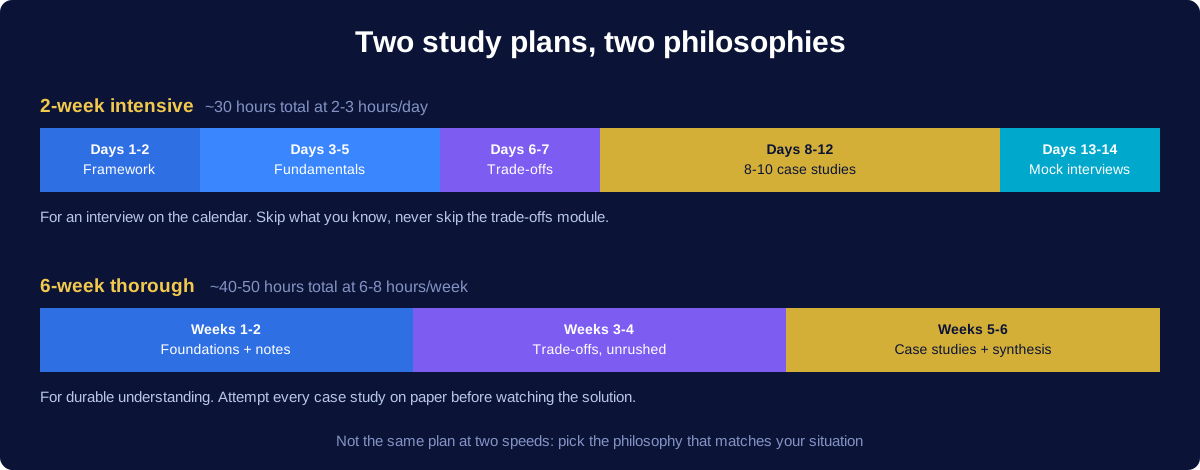
The 2-week intensive plan
For engineers preparing for an interview within 2-3 weeks. Roughly 2-3 hours per day.
Week 1: Framework and Fundamentals
Days 1-2: Introduction and meta-skills (~4 hours)
- All of Chapter 1 (Introduction to System Design Interviews)
- Master Template lesson from Chapter 4
- Watch the framework video twice
Goal: lock down the 6-step framework as muscle memory. You'll apply it in every case study going forward.
Days 3-5: Fundamentals (~7 hours)
- All of Chapter 2 (Glossary of System Design Basics)
- Skip familiar concepts, focus on areas where you feel less confident
Goal: confirm vocabulary. If you already know what a load balancer is, just verify the framing the course uses and move on.
Days 6-7: Trade-offs Module (~5 hours)
- All of Chapter 3 (System Design Trade-offs)
- Do not skip this chapter. Even if topics feel familiar, the framing shows you how to talk about trade-offs in an interview.
Goal: build the trade-off vocabulary you'll use to defend design decisions.
Week 2: Case Studies and Practice
Days 8-12: Real Interview Problems (~10 hours)
- 8-10 case studies from Chapter 4 that match systems likely to come up in your interview
- Recommended priority order: URL Shortener, Instagram, Twitter, Uber, Facebook Messenger, Dropbox, YouTube/Netflix, API Rate Limiter
- For each: attempt your own design on paper for 20 minutes, then watch the solution
Goal: apply the framework to varied problems. Active attempt before watching is the highest-leverage habit you can build.
Days 13-14: Mock Interviews and Review (~4 hours)
- 2-3 mock interviews with a friend or paid platform
- Review weakest areas from your mocks
- Reread your own notes on trade-offs
Goal: convert framework knowledge into framework reflexes under pressure.
Total time: ~30 hours over 14 days at 2-3 hours per day.
You won't have absorbed everything in this plan. You will have enough framework, vocabulary, and case study experience to perform competently in a system design interview.
The 6-week thorough plan
For engineers without immediate interview pressure who want durable understanding. Roughly 6-8 hours per week.
Weeks 1-2: Foundations
- Chapter 1 (Introduction): 1 day
- Chapter 2 (Fundamentals): 1.5 weeks at 4-6 hours/week
- Take notes on each concept. Build a personal reference document you can come back to.
- Don't move on until you can explain each concept to yourself in plain English.
Weeks 3-4: Trade-offs
- Chapter 3 (Trade-offs): 2 weeks at 4-6 hours/week
- This is the most important chapter. Do not rush it.
- For each trade-off lesson: write down a real-world example of when you'd choose each side. Adds depth that pure passive consumption misses.
Weeks 5-6: Case Studies and Synthesis
- Chapter 4 (Real Interview Problems): 2 weeks at 6-8 hours/week
- For each case study: attempt your own design on paper for 30 minutes before watching the solution. This is the single highest-leverage habit in the course.
- Compare your design to the solution. Note where your reasoning was different and why.
- After completing 8-10 case studies, look for the patterns across them. The course is teaching pattern recognition, and the patterns become visible by case study 6 or 7.
Total time: ~40-50 hours over 6 weeks at 6-8 hours per week.
This is the path that produces strong interview performance and durable system design intuition. It's also the path that makes the course pay back over years, not just for a single interview.
Where most readers slow down
A few specific places where readers tell us they spend more time than they expected:
The trade-offs module (Chapter 3). 23 lessons covering comparisons most engineers haven't formalized. Readers often tell us this is where they slow down significantly, and that the time investment is worth it. Don't rush this chapter.
Case studies in Chapter 4. A 45-minute case study lesson can take 90 minutes to fully work through if you do it actively (attempt your own design first, then compare to the solution). The active approach is correct. Plan for the longer time.
Concepts that intersect with your weak areas. If sharding has always confused you, the sharding lesson will take longer. That's the lesson doing its job. Spend the time.
The system design master template lesson. Short lesson, but worth rewatching multiple times. The template is what you'll actually apply in every interview.
If you're spending more time on these than you planned, that's typically a feature, not a bug. The total time grows but the durability of the learning grows faster.
Realistic expectations by week
For readers on the 6-week thorough plan, here's what you should reasonably expect:
End of week 1: You can name and roughly describe the major system design building blocks. You haven't internalized them yet.
End of week 2: Vocabulary feels comfortable. You can explain concepts back to yourself, but you'd still struggle to apply them under pressure.
End of week 3: You start recognizing trade-offs in the systems around you (your own work, products you use). This is the first real signal that the course is producing intuition rather than just knowledge.
End of week 4: Trade-offs feel natural. You can articulate why you'd choose strong vs. eventual consistency for a specific use case without having to look it up.
End of week 5: You're working through case studies and recognizing patterns you've already seen in other problems.
End of week 6: Without notes, you can take a system design problem you haven't seen before and walk through a reasonable design using the 6-step framework. This is the destination.
If you're significantly behind these benchmarks, that's a signal to slow down, not speed up. Forcing pace produces false confidence.
How to know if you're on track
Three checkpoints that work better than calendar progress:
Can you explain a concept in your own words without notes? If yes, you've internalized it. If no, you've memorized it. Internalization is the goal.
Can you predict the next slide before it appears? As you progress, you should start anticipating where the course is going. If you're surprised by every solution, you're not building intuition yet.
Can you apply the framework to a problem the course doesn't cover? Pick a system you know (a product you use daily) and try designing it using the 6-step framework. If you can structure the conversation, you're ready for interviews.
These checkpoints matter more than "I'm on Week 4." Some readers hit them in 3 weeks, some in 8. Both are fine.
What to do if you're falling behind
If you're consistently spending more time than planned and falling behind your timeline:
First, evaluate whether falling behind is a problem. If you have no specific interview pressure, taking longer is not a failure. Adjust the timeline rather than rushing.
Second, audit how you're studying. Are you watching at 1x speed when 1.25x would work? Are you taking exhaustive notes when bullet points would do? Some readers slow themselves down through over-thoroughness.
Third, prioritize the high-leverage chapters. If time is genuinely tight, the framework, the trade-offs module, and 6-8 case studies are the irreducible minimum. Everything else can be skipped or skimmed.
Fourth, consider whether the timing is right at all. If you can't sustain even 6 hours per week of focused study, this might not be the right time to take the course. The free tier doesn't expire. Come back when you have the bandwidth.
The honest bottom line
For an engineer with mid-level experience who can spend 1-2 hours per day, plan for 3-4 weeks to finish the course thoroughly. If you have a specific interview in 2 weeks, the intensive plan above will get you ready in that window. If you're learning for general career growth without time pressure, plan for 6-8 weeks at a sustainable pace, and you'll come out with stronger durable understanding than the cram path produces.
The numbers vary by experience and goal. The plans above give you a structure to fit your specific case.
If you're trying to decide whether to enroll in the first place, the honest review covers strengths and weaknesses, and includes a five-question worth-it decision framework. If you want to compare the course to alternatives, the comparison with Alex Xu's books covers the most common alternative.
Frequently Asked Questions
How long does it take to finish Grokking the System Design Interview?
The course contains roughly 20 hours of content (15 hours of video + 5 hours of text). Most learners finish in 2 to 4 weeks at 1 to 2 hours per day. Senior engineers can finish in 1 to 2 weeks. Junior engineers studying deeply may take 1 to 3 months.
Can I finish Grokking the System Design Interview in a weekend?
Technically possible to watch the videos in two days, but you won't internalize the framework or the trade-offs vocabulary. The course's value comes from absorption, not exposure. If you have a weekend before an interview, focus on the framework lesson, the trade-offs module, and 4-5 case studies rather than rushing through everything.
Is 2 weeks enough to finish the course?
For senior engineers, yes. For mid-level engineers, yes if you can commit 2-3 hours per day. For junior engineers, 2 weeks is rushed and you'll miss depth. The 2-week intensive plan in this post shows how to do it if you have to.
How long is each lesson in Grokking the System Design Interview?
Lessons vary from 5 to 25 minutes each, depending on topic. Fundamentals lessons tend to be shorter (5-15 minutes). Case study lessons tend to be longer (15-25 minutes), and a 20-minute case study can take 60+ minutes to actively work through.
How many hours per day should I spend on the course?
For interview prep with a deadline: 2-3 hours per day. For thorough learning without deadline pressure: 1-2 hours per day or 6-8 hours per week spread however works for you.
What if I fall behind on the suggested timeline?
Falling behind isn't usually a problem unless you have a hard interview deadline. The timelines in this post are guidelines, not requirements. If the material is taking longer to absorb, that's typically a sign you're learning correctly, not failing.
Do I need to do all 15 case studies?
No. The 8-10 most commonly asked are the priority. URL Shortener, Instagram, Twitter, Uber, Facebook Messenger, Dropbox, YouTube/Netflix, and API Rate Limiter cover most interview scenarios. The remaining case studies are valuable but not essential for most readers.
Can I skip the fundamentals chapter if I'm experienced?
Skim it rather than skip it. Even experienced engineers benefit from confirming the course's framing for concepts they already know. Skipping entirely risks missing vocabulary the course assumes you have for later chapters.
Should I take notes while going through the course?
Yes for most readers. Especially in the trade-offs module. Active note-taking improves retention significantly compared to passive watching, and the notes become useful pre-interview review material.
Is there a faster way to prepare if I have less than a week?
For less than 7 days, the course alone won't be sufficient. Use the framework lesson, the trade-offs module, and 3-5 high-priority case studies as a focused subset. Supplement with mock interviews. Or consider the System Design Interview Crash Course which is designed for time-constrained preparation.
Related reading
- A beginner's guide to system design interviews. Where to start with no experience: the vocabulary first, then a template, then practice.
- Grokking the System Design Interview Review: Is It Worth It?. Detailed founder review of what works, what doesn't, and a five-question decision framework for enrolling.
- Grokking the System Design Interview vs Alex Xu Books: An Honest Comparison. Side-by-side with the most popular alternative.
- About Grokking the System Design Interview. The complete guide to the course.
- The Full Curriculum. Every lesson with a one-line description.
- The Complete Interview Guide. The 6-step framework, time-boxing a 45-minute interview, and a separate 8-week interview prep plan.
Ready to start?
Whether you have 2 weeks or 6 weeks, the most reliable next step is the free tier. Spend 30-60 minutes with the introductory content to confirm the format works for you. Then pick the plan above that matches your situation and start.