Disclosure: I built Grokking the System Design Interview, which competes with both of these products. I have tried to describe each one accurately, using the prices and features on their own sites, and to say plainly where each is better than the other. My own course appears once, near the end, and you can skip that section.
Hello Interview and ByteByteGo are the two names that come up most often when engineers ask where to prepare for a system design interview. They look similar from a distance, because both cover system design and both have expanded into other interview rounds. Up close they are different kinds of products. Hello Interview is a practice platform built around guided exercises and an AI interviewer. ByteByteGo is a library of illustrated, book-style courses that you read.
This page compares them on the things that decide which one helps you: how each one teaches, what each covers, how you practice, and what each costs.
The short answer
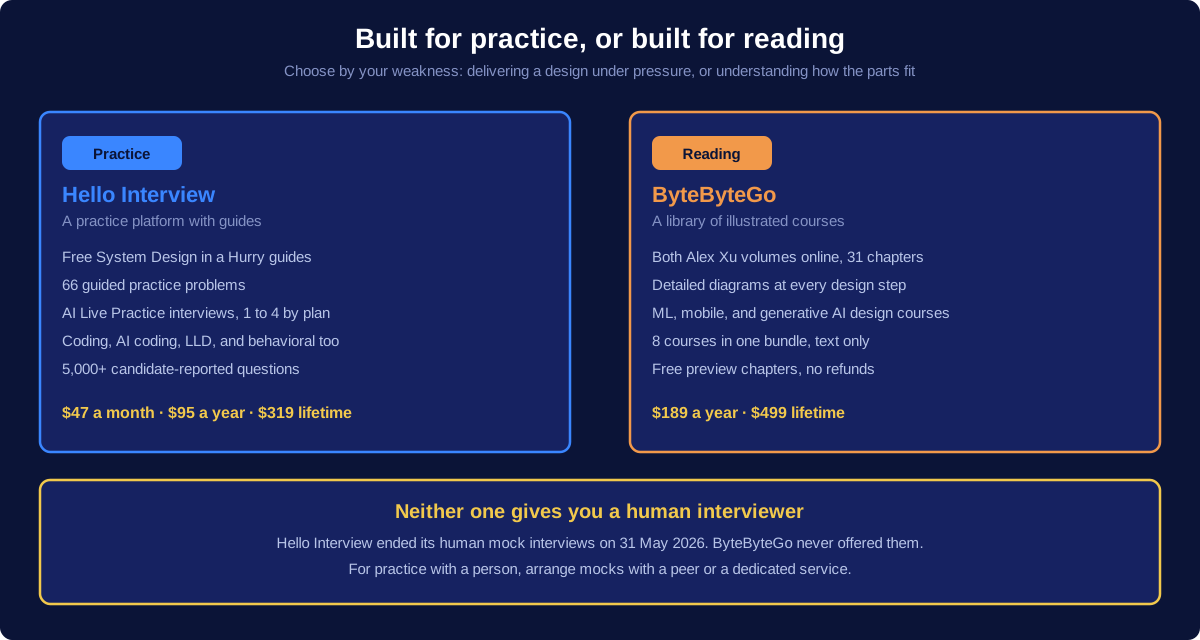
- Choose Hello Interview if you learn by doing, you want practice that talks back to you, and you want coding and behavioral preparation in the same subscription. Its free system design guides are also good enough to start with before you pay anything.
- Choose ByteByteGo if you learn best by reading clear explanations with detailed diagrams, you want the Alex Xu books online in one place, and you also need machine learning, mobile, or generative AI system design.
- Use both if you have the budget and more than a month: read ByteByteGo for understanding, then use Hello Interview to practice producing designs under time pressure.
What Hello Interview is
Hello Interview is a technical interview preparation platform founded by Evan King and Stefan Mai, both formerly senior engineers at Meta and Amazon. It began as a system design resource and now covers system design, low-level design, coding, AI-assisted coding, and behavioral interviews.
Its best-known material is a set of written guides called System Design in a Hurry. The guides start with a named method for running the interview, which Hello Interview calls the Delivery Framework. They then cover core concepts, key technologies, common patterns, and more than 30 worked problems such as a URL shortener, Dropbox, Uber, and a web crawler. A large share of these guides is free to read without an account.
The paid tier, called Premium, adds 28 videos, 66 guided practice problems, a library of more than 5,000 interview questions reported by candidates, and an AI tutor that answers questions while you study. It also includes Live Practice: an AI interviewer that runs a full system design interview out loud and returns a hire or no-hire decision with a written report.
For a fuller description of the system design track, see the Hello Interview system design explainer.
What ByteByteGo is
ByteByteGo is the online home of Alex Xu's interview books and the courses built around them. It is known for its diagrams, which explain each design visually and in more detail than most competitors. Its newsletter and social channels each report more than a million followers, which is a large part of how most engineers first encounter it.
Its paid plans unlock a bundle of eight courses:
- System Design Interview
- Coding Interview Patterns
- Object-Oriented Design Interview
- Machine Learning System Design Interview
- Mobile System Design Interview
- Generative AI System Design Interview
- Behavioral Interview
- How to Write a Good Resume
The System Design Interview course is the online version of both volumes of Alex Xu's books, in 31 chapters. It starts with scaling a system from one user to millions, estimation, and an interview framework, then works through about 25 design problems, from a rate limiter and a URL shortener to a payment system and a stock exchange.
The courses are text with detailed illustrations. They do not include video lessons, although ByteByteGo publishes free videos separately on YouTube. Preview chapters are free, so you can judge the style before you pay.
Side by side
| Hello Interview | ByteByteGo | |
|---|---|---|
| What it is | Practice platform with guides | Library of illustrated courses |
| How you learn | Read a guide, then practice and get feedback | Read chapters with detailed diagrams |
| System design problems | More than 30 worked problems | About 25 design chapters across two volumes |
| Other rounds covered | Low-level design, coding, AI coding, behavioral | Coding, OOD, ML, mobile, generative AI, behavioral, resume |
| Video | 28 premium videos | No course video; free YouTube channel |
| Practice with feedback | Guided practice, AI tutor, AI Live Practice interviews | Not the focus; an AI assistant answers questions about the books |
| Human mock interviews | Ended on 31 May 2026 | Never offered |
| Free material | Large share of the system design guides | Preview chapters and the curriculum |
| Cheapest paid option | $47 for one month | $189 for one year |
| Lifetime price | $319 | $499 |
How each one teaches
The clearest difference is what you do while you study.
On ByteByteGo, you read. Each chapter states a problem, narrows the requirements, estimates the scale, and builds the design one component at a time, with a diagram at each step. The diagrams are the strongest part of the product. They show how data moves through a system in a way that a paragraph of text cannot, and many engineers say the designs only made sense to them once they saw them drawn this way.
On Hello Interview, you read less and attempt more. The guides are shorter and more direct, and the paid tier is built around producing your own answer. Guided practice walks you through a problem one decision at a time. Live Practice then asks you to run the whole interview yourself, out loud, and grades the result.
Both approaches work, but they fix different weaknesses. If your problem is that you do not yet understand how a distributed cache or a message queue fits into a design, reading clear explanations fixes that. If you understand the parts but stall when an interviewer says "design a ride-sharing service" and waits, only practice fixes that.
Coverage beyond system design
Both products have grown well past system design, and the extra courses can decide the choice by themselves.
ByteByteGo covers more specialized design rounds. Its machine learning, mobile, and generative AI system design courses address interviews that Hello Interview covers less thoroughly or not at all in its paid tier. If your target role is a machine learning engineer or a mobile engineer, this is a real advantage.
Hello Interview covers the rounds that most software engineering loops contain. Its coding, AI-assisted coding, low-level design, and behavioral courses are all inside the same subscription, alongside the question library, which lets you see what specific companies have recently asked.
Pricing compared
The two companies price in different shapes. Hello Interview sells short access. ByteByteGo sells a year or a lifetime.
| Plan | Hello Interview | ByteByteGo |
|---|---|---|
| 1 month | $47 (list $59) | Not offered |
| 1 year | $95 (list $119) | $189 (list $399) |
| Lifetime | $319 (list $399) | $499 (list $999) |
Both companies show a higher list price next to the price you actually pay, and the table shows both. Hello Interview's lifetime plan never auto-renews, and an annual plan can be upgraded to lifetime later with the remaining time credited. ByteByteGo states that refunds are not available for its courses, so read the free preview chapters before you buy.
The practical consequence is about timing. If your interview is three weeks away, Hello Interview's one-month plan is the cheapest way to get a complete paid product. If you expect to interview several times over the next few years, or you want the books as a permanent reference, ByteByteGo's lifetime plan is worth comparing closely, because it covers eight courses for its price.
Mock interviews and practice
For years, Hello Interview's most distinctive feature was a marketplace of mock interviews with current and former interviewers from large tech companies. Hello Interview ended its human mock interview and mentorship programs on 31 May 2026 and refunded unexpired credits. Many comparison articles still recommend it for that marketplace, and that advice is now out of date.
What replaced it is AI-run practice. Every Premium plan includes Live Practice interviews: one with a month of access, two with a year, and four with lifetime. Hello Interview says the feedback is calibrated against more than 10,000 human-led mock interviews with interviewers from large tech companies.
ByteByteGo has never offered mock interviews. Its paid plans include an AI assistant trained on its books, which is useful for asking follow-up questions about a chapter, but it does not interview you.
So neither product gives you a human interviewer. If practice with a person matters to your plan, arrange it with a peer or a dedicated mock interview service, whichever product you choose.
Where Hello Interview is stronger
- Practice is built in. Guided practice and Live Practice make you produce designs, which is the skill the interview actually tests.
- The free material is substantial. You can learn a real amount from the free system design guides before deciding whether to pay.
- Short commitments are cheap. One month for $47 suits an interview that is already scheduled.
- Recent questions. The library of more than 5,000 candidate-reported questions helps you prepare for a specific company.
Where ByteByteGo is stronger
- The diagrams. The visual explanations are the clearest in this category for understanding how a design fits together.
- Depth of written explanation. Each design is explained in full, which suits engineers who need to understand a system before they can discuss it.
- Specialized design rounds. Machine learning, mobile, and generative AI system design are each a full course.
- A permanent reference. The lifetime plan gives you the books and seven other courses to return to between interviews.
Which one fits which engineer
You have an interview in the next few weeks. Hello Interview. Read the free guides first, then buy one month and spend it on guided practice and Live Practice.
You are early and the vocabulary is still unfamiliar. ByteByteGo, or the free Hello Interview guides if budget is tight. You need explanations before practice can help.
You are interviewing for a machine learning or mobile role. ByteByteGo, because its specialized design courses match those rounds.
You need coding, behavioral, and system design in one place. Either works, but Hello Interview's coding and behavioral material is closer to what a standard software engineering loop asks.
You freeze when asked to design something on your own. Hello Interview. That is a practice problem, and reading more will not solve it.
Can you use both?
Yes, and for a longer preparation period it is a sensible combination, because the two products are strong in opposite places. A practical sequence is to read the relevant ByteByteGo chapters to understand a problem, then attempt the same kind of problem on Hello Interview without looking at the answer. Reading builds the understanding, and practice turns it into something you can deliver under time pressure.
The cost of both is high, though. If you can only buy one, decide by your weakness: understanding or delivery.
Where Grokking fits
Since I built a competitor, here is the one paragraph about it. Grokking the System Design Interview sits between the two. It is a structured course that teaches one repeatable method and then applies it to 15 problems worked end to end, with video walkthroughs, interactive diagrams, and 237 quizzes. It costs $59 once for lifetime access. It does not run mock interviews either. If you want to compare it directly with either product, see Grokking vs Hello Interview and Grokking vs ByteByteGo.
Frequently asked questions
Is Hello Interview or ByteByteGo better for system design interviews?
Neither is better for everyone. Hello Interview is better if you need practice producing designs and getting feedback. ByteByteGo is better if you need clear, detailed explanations of how systems are built. Choose by whether your weakness is delivery or understanding.
How much does Hello Interview cost compared with ByteByteGo?
Hello Interview costs $47 for one month, $95 for one year, or $319 for lifetime access. ByteByteGo costs $189 for one year or $499 for lifetime access and has no monthly plan. Both show higher list prices next to these.
Does Hello Interview still offer mock interviews?
Not with human interviewers. Hello Interview ended its human mock interview program on 31 May 2026. Its Premium plans now include AI-run Live Practice interviews: one with a month, two with a year, and four with lifetime.
Does ByteByteGo have video courses?
No. ByteByteGo's courses are text with detailed illustrations. It publishes free videos on its YouTube channel, but those are separate from the paid courses.
Is ByteByteGo the same as Alex Xu's books?
The System Design Interview course on ByteByteGo is the online version of both volumes of Alex Xu's System Design Interview books. The paid plans also include seven other courses, such as machine learning and mobile system design.
Which one is better for machine learning system design?
ByteByteGo, because it has a full Machine Learning System Design Interview course in its bundle. Hello Interview publishes ML system design guides, but its paid tier is built around system design, coding, low-level design, and behavioral rounds.
Can I prepare using only the free material?
You can get a long way with Hello Interview's free system design guides, which cover the method, the core concepts, and many worked problems. ByteByteGo's free material is limited to preview chapters, which are enough to judge the style but not to prepare.
Related reading
- Hello Interview System Design: Coverage, Pricing, and Fit, for the full description of Hello Interview's system design track
- Hello Interview Alternatives: 6 Options Compared, if neither product fits
- Grokking the System Design Interview vs Alex Xu's Books, for the books behind ByteByteGo
- Grokking the System Design Interview Alternatives: 7 Options, for the wider set of options
Read both free tiers before you pay for either. Hello Interview's free guides and ByteByteGo's preview chapters are enough to tell you which way of learning suits you, and that matters more than any feature table.