
A disclosure before anything else: I created Grokking the System Design Interview, a paid course, and this post discusses whether free AI chatbots can replace something like it. Obvious conflict of interest. I've tried to handle it the way I always do: by being specific about what AI chat genuinely does well (a lot), and by giving you the exact prompts I'd use if I were preparing with it. If the post reads like "AI bad, buy my course," push back. That's not the argument I'm making.
Every week, engineers ask some version of this question: "I have ChatGPT. Why would I pay for a system design course?" It's a fair question, and it deserves a better answer than either "AI changes everything" or "AI is useless for this."
The honest answer: AI chat is the best on-demand tutor that has ever existed, and it is structurally bad at the specific things that make interview preparation work. Both halves of that sentence are true at the same time. This post walks through them, plus the practical part: how I'd actually use ChatGPT or Grok if I were preparing today.
First, the name collision: Grok vs Grokking
Worth clearing up, because search results mix these together constantly.
Grok is xAI's chatbot. Grokking the System Design Interview is the course I created. Both names come from the same place: Robert Heinlein coined "grok" in Stranger in a Strange Land to mean understanding something so completely that it becomes part of you. That's what the course name has always meant, years before AI chatbots existed. If you searched "grok system design" and landed here, you might have wanted either one, and this post covers the intersection: whether an AI chatbot, Grok included, can get you interview-ready.
For what the course itself is, the course overview covers that. From here on, "AI chat" means any of the frontier chatbots: ChatGPT, Grok, Claude, Gemini. For this use case they're more alike than different.
What AI chat is genuinely good at
Let me start with the strengths, because they're real and I use them myself.
Explaining concepts on demand, at your level. This is the killer feature. If consistent hashing doesn't click, you can ask for it five different ways: with an analogy, with a worked example, compared to naive hashing, at a junior level, then deeper. A course or book explains a concept once, the way the author chose. A chatbot re-explains until it lands. For pure concept acquisition, AI chat is genuinely better than any static resource ever written.
Unlimited follow-up questions. The moments where you'd stall on a book ("wait, why does the leader handle writes?") become thirty-second detours instead of rabbit holes. Momentum matters in study, and AI chat preserves it.
Generating practice variations. "Give me five system design questions like 'design a URL shortener' but harder" works well. So does "quiz me on the trade-offs between SQL and NoSQL until I get three right in a row."
Reviewing your own notes. Paste your study notes and ask it to find gaps or quiz you from them. Retrieval practice against your own material is one of the most effective study techniques there is, and AI makes it frictionless.
If your prep problem is "I don't understand the building blocks," AI chat solves it about as well as anything can.
Where it quietly fails you
Here's the other half, and the reason "just use ChatGPT" produces confident candidates who underperform in real interviews.
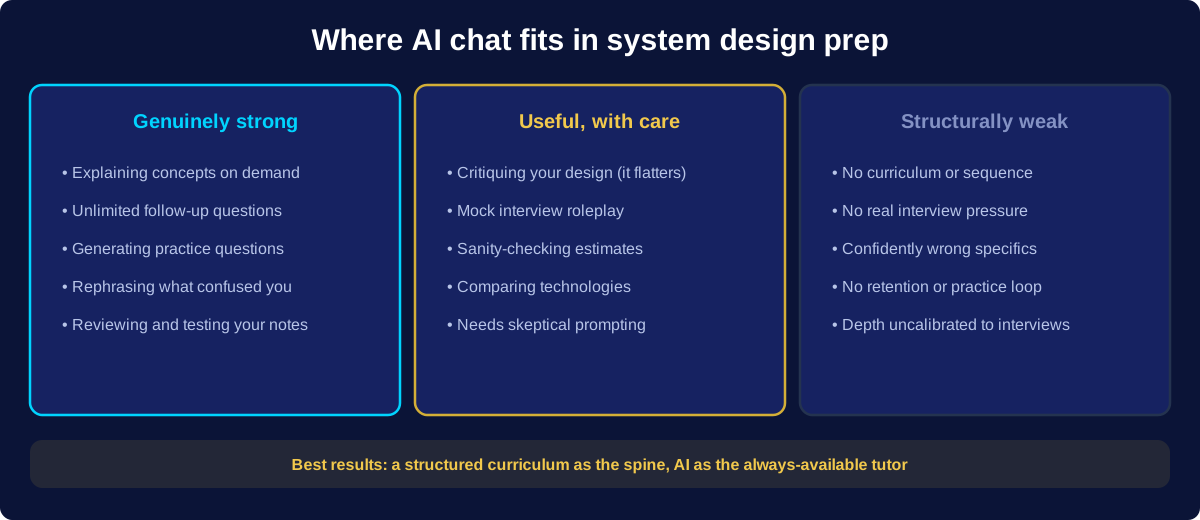
1. It flatters your designs. This is the big one. Ask a chatbot to review your system design and it will tell you the design is solid, list a few gentle improvements, and congratulate you. Interviewers do the opposite: they probe the weakest point, push until something breaks, and watch how you respond. AI models are trained to be agreeable, and agreeableness is precisely the wrong training partner for interviews. You can partially fix this with prompting (more below), but the default behavior builds false confidence, which is worse than no feedback at all.
2. It has no idea what you don't know. A curriculum's real value isn't the content, it's the sequence: someone who has watched thousands of engineers learn this material decided what you need first, what depends on what, and what interviews actually weight. Chat sessions have no map of your gaps. Engineers who prep by freeform conversation reliably over-study what they find interesting and skip what they'd be probed on. You can't ask AI to fill gaps you don't know you have.
3. It's confidently wrong about specifics. For broad concepts, frontier models are quite reliable now. For specifics (throughput numbers, how a particular database handles failover, what a "typical" QPS estimate should be), they hallucinate fluently. In an interview, quoting a wrong number you absorbed from a chatbot is worse than saying "I'd need to verify this." The errors are unmarked, which means you'd need existing expertise to catch them, which is exactly what you don't have yet.
4. There's no pressure, no clock, and no stakes. A system design interview is 45 minutes, whiteboard, someone watching you think. The skill that fails first under those conditions isn't knowledge, it's structure: what to do in which order, what to say while you think. Chatting at midnight in your kitchen trains none of that. This is why the course drills a 6-step framework until it's reflex, and why mock interviews with humans remain irreplaceable in the final weeks.
5. There's no retention loop. Conversations feel like learning while you're in them, then evaporate. Study systems build in recall: quizzes, spaced review, attempting problems before seeing solutions. Chat gives you the feeling of understanding without the forcing functions that make it stick. (You can build your own loop with prompts, but almost nobody sustains that discipline for four weeks.)
The comparison, honestly
| AI chat (ChatGPT, Grok, etc.) | A structured course | |
|---|---|---|
| Explaining a concept you name | Excellent, adapts to you | Good, one fixed explanation |
| Knowing what you should study next | None, you steer | The entire point of a curriculum |
| Design feedback | Agreeable by default | Calibrated to what interviews probe |
| Accuracy on specifics | Unmarked errors | Reviewed and corrected over years |
| Interview pressure practice | Absent | Framework drills + timed case studies |
| Retention | Up to your discipline | Quizzes and active-recall loops built in |
| Cost | Free to ~$30/month | Free tier, then paid |
The pattern in that table isn't "course wins." It's that they're good at different layers. AI chat is a tutor. A curriculum is a map plus a training plan. Preparation needs both layers, and AI chat only provides one.
How I'd actually use ChatGPT or Grok for prep
If you're going to use AI chat in your preparation (you should), here's the version that works, in the form of the prompts that matter:
Kill the flattery explicitly. "Act as a skeptical FAANG interviewer. Do not validate my design. Find the weakest component and drill into it with follow-up questions, one at a time. Do not move on until I've addressed it or admitted I can't." This gets you maybe 60% of a real interviewer's pushback, which is far better than the default 5%.
Make it ask, not tell. "I'm going to design a rate limiter out loud. Ask me one clarifying question at a time, the way an interviewer would. Don't show me a solution at any point." The moment AI shows you its solution, you stop generating and start recognizing. Recognition feels like competence and isn't.
Use it after your attempt, never instead of one. Attempt the design on paper first, then paste it in for critique. This mirrors the highest-leverage habit in all of system design prep: attempt before solution. It's the same principle behind the AI design playground we built into the course, with one difference worth being upfront about: the playground evaluates your attempt against the specific patterns the curriculum teaches, while a general chatbot evaluates it against a vague average of the internet. Grounding matters for feedback quality.
Verify numbers elsewhere. Anything quantitative that you plan to say in an interview (capacity estimates, latency budgets, storage math), cross-check against a source that can't hallucinate. Your own back-of-the-envelope arithmetic is the best option, and interviewers respect it far more than recited figures anyway.
Don't let it set the syllabus. Take the sequence from a curriculum (the full course curriculum is free to browse, whether or not you enroll) and use AI to go deeper on each stop. "Explain it again, differently" is the right job for chat. "What should I learn?" is not.
So: can it prepare you?
Alone? For a first system design interview, no, and the failure mode is predictable: you'll understand many concepts, hold conversations about architecture, and then structure will collapse in minute twelve of a live interview because nothing in your prep resembled one. AI chat also can't tell you this is coming, because it has no model of what your interview will actually test.
As one layer of preparation? Absolutely, and I'd say anyone preparing today without an AI tutor open in a second tab is leaving value on the table.
The combination that works, for most engineers, in order:
- A structured path for sequence and coverage: a course like Grokking the System Design Interview, a book, or a free-materials route like the one in the free-version guide. What matters is that something with a map decides your sequence.
- AI chat as the tutor at every step: re-explanations, follow-ups, quizzing, post-attempt critique with the skeptical-interviewer prompt.
- Humans for pressure in the final two to three weeks: mock interviews, with peers or paid, because no model simulates being watched.
Whether the structured layer should be my course specifically is a separate question, and the honest review exists to help you answer it, including the cases where the answer is no.
Frequently Asked Questions
Can ChatGPT prepare you for a system design interview?
As a tutor alongside a structured plan, yes, and it's excellent in that role. As your only preparation, no. AI chat explains concepts well but provides no curriculum sequence, flatters your designs by default, and trains none of the time-boxed structure that live interviews test.
Is Grok the same thing as Grokking the System Design Interview?
No. Grok is xAI's chatbot. Grokking the System Design Interview is the original system design prep course. Both names derive from Heinlein's word "grok," meaning to understand deeply, which is the extent of the connection.
Can I use ChatGPT or Grok as a mock interviewer?
Partially. With explicit prompting ("act as a skeptical interviewer, one question at a time, never validate"), you get useful practice at articulating designs under questioning. You don't get real pressure, real time constraints, or a human's judgment. Use AI roleplay in the middle of your prep and real mock interviews in the final weeks.
Will interviewers care that I prepared with AI?
No interviewer asks how you prepared. What they notice is whether your structure holds under pressure and whether your numbers survive scrutiny. AI-heavy prep tends to produce strong vocabulary and weak structure, which experienced interviewers spot quickly. Balance it with framework drills and live practice.
Does Grokking the System Design Interview use AI itself?
Yes. The current course includes an AI design playground (sketch your own design, get feedback graded against the course's patterns before seeing the solution) and an inline explainer on every lesson. Both are included in the free tier. The update rundown covers them in detail.
What's the best free way to combine AI with structured prep?
Browse the free curriculum for sequence, study each topic with the free tier of the course plus AI chat for depth, attempt case studies on paper before asking AI to critique them, and use the free interview guide for the framework. That stack costs nothing and beats freeform chatting by a wide margin.
Related reading
- What's New in Grokking System Design. Including the AI design playground and inline explainer, and why grounded AI feedback beats generic chat.
- Grokking the System Design Interview Review: Is It Worth It?. The honest founder review, with a five-question framework for deciding.
- Is There a Free Version of Grokking the System Design Interview?. The legitimate free-materials path, honestly assessed.
- The Complete Interview Guide. The 6-step framework AI chat can't drill into you, free on this site.
- The Full Curriculum. Every lesson, free to browse, useful as a study map even if you never enroll.
Try grounded AI feedback free
The AI design playground and inline explainer are included in the course's free tier, no payment details required. Sketch a design for a problem you haven't seen, get feedback calibrated to what interviews actually probe, and compare it to what your chatbot told you about the same design. The difference is the point.