Two facts make the Microsoft loop different from the other large companies. The questions are not drawn from a central bank: each team builds its loop from the problems it actually works on. And the loop ends with an As-Appropriate round, a final interview with a senior person whose opinion carries the most weight in the decision.
Both facts reward the same preparation: learn what the team you are interviewing with builds. A candidate interviewing with an Azure storage team and a candidate interviewing with a Teams feature crew are preparing for different interviews, and Microsoft is unusual in how true that is.
This article covers the Microsoft loop, the As-Appropriate round, the enterprise themes Microsoft pushes on that other companies do not, and what to practice by level.
The Microsoft loop, round by round
The process usually starts with a recruiter screen, then an online assessment or a technical phone screen. Passing those leads to the loop: four to five interviews of about an hour each, often on one day.
A common loop for an experienced engineer looks like this:
| Round | Length | What it covers |
|---|---|---|
| Coding | About 1 hour | Data structures and algorithms, plus behavioral questions |
| Coding | About 1 hour | More coding, same format |
| System design | About 1 hour | One open design question, conversational |
| Coding or domain round | About 1 hour | Team dependent |
| As-Appropriate | About 1 hour | Senior leader, technical plus behavioral, comes last |
Microsoft mostly does not run a separate behavioral round below the senior levels. Behavioral questions are woven into the technical rounds instead, a few minutes at a time. So every round is partly a behavioral round, which is closer to Amazon's format than to Google's separate Googleyness interview.
Because loops are team-owned, the exact shape varies more at Microsoft than at Amazon, Google, or Meta. Ask your recruiter what rounds are scheduled and which team owns the loop. Both answers change your preparation.
The As-Appropriate round
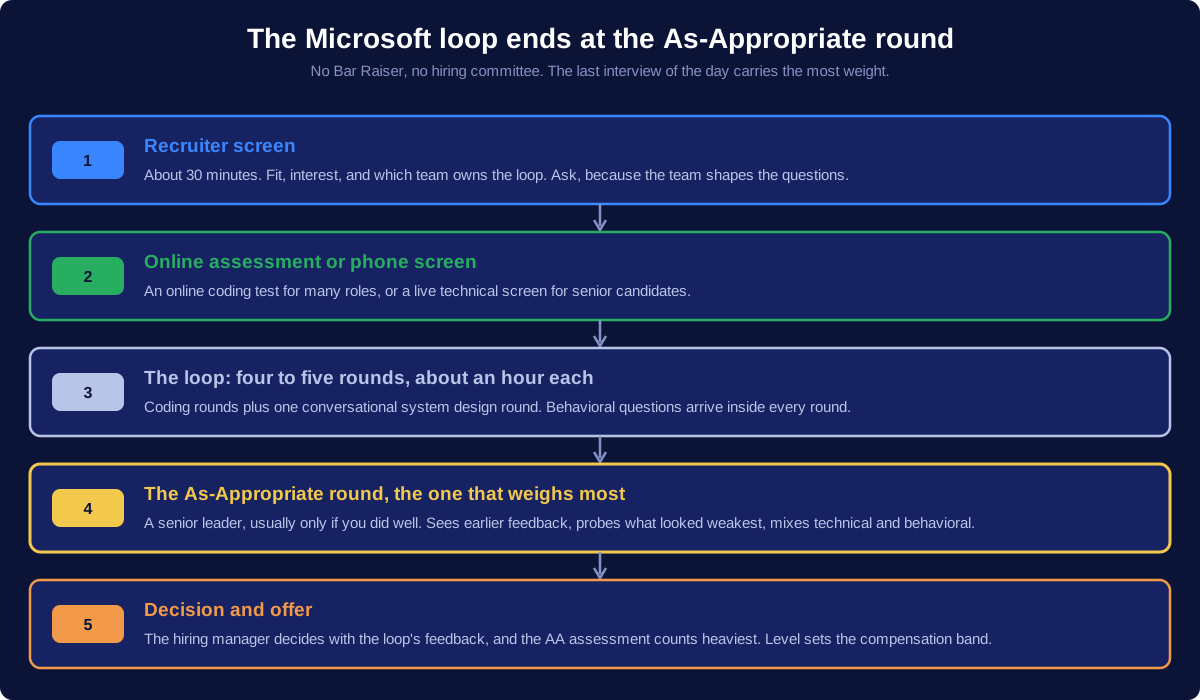
The final interview is called As-Appropriate, often shortened to AA. It is conducted by a senior person, usually the hiring manager's manager or another senior leader, and it typically happens only if the earlier rounds went well. Reaching it is a good sign.
Two things distinguish it.
It carries the most weight. Microsoft has no Bar Raiser with a veto and no hiring committee reading packets. The AA interviewer sees the earlier feedback, probes whatever looked weakest, and their assessment counts heaviest in the final decision.
It mixes technical and behavioral freely. Expect a shorter design or architecture discussion, questions about your past decisions, and questions about how you handle being wrong. Microsoft screens hard for what it calls a growth mindset: whether you treat pushback as information or as attack. The AA round is where that is tested most directly.
The practical consequence: do not relax after the design round. Keep one design story and one being-wrong story ready for the last conversation of the day.
The design round: a conversation, not a presentation
The system design round runs about an hour, and behavioral questions take only a few minutes of it. The rest is yours to design in, but not uninterrupted. Microsoft interviewers engage constantly: questioning choices, adding constraints, and steering toward the parts they care about.
This is worth rehearsing for. A candidate who prepared a polished monologue reads the interruptions as failure and loses composure. A candidate who expects a working session reads them correctly: the interviewer is showing you what the team actually cares about, because the question came from their real work.
A workable split of the hour: five minutes on requirements, five on scale estimation, twenty on the high-level design, twenty on the deep dive the interviewer steers you into, and the rest on trade-offs and questions.
The themes Microsoft pushes that others do not
Microsoft sells software to enterprises, and its design questions carry that context. Four themes appear at Microsoft more than at Google, Meta, or Amazon:
Multi-tenancy. One deployment serving many customer organizations, called tenants, with isolation between them. Who can see whose data, how one tenant's load is kept from another, and what a per-tenant limit looks like. If you learn one extra topic for Microsoft, learn this one.
Backward compatibility. Microsoft products carry decades of existing users and file formats. Expect follow-ups about what happens to old clients when your design changes an API.
Enterprise security and compliance. Data residency, audit logs, and admin controls are normal follow-up territory, not exotic extras.
Cloud services as building blocks. Interviewers often frame components in Azure terms. You do not need Azure product names; you need the generic equivalents: object storage, managed queues, serverless functions, and a managed database. Saying the concept is enough.
What changes by level
Microsoft levels start at 59 for a new engineer. The design bar moves with the number:
| Level | Title | What separates a pass from a fail |
|---|---|---|
| 59 to 60 | SDE | Mostly coding. Clear structure if design appears |
| 61 to 62 | SDE II | A complete design with reasoned trade-offs, some steering allowed |
| 63 to 64 | Senior SDE | Design is the round that decides. Constraints, failure handling, tenant isolation |
| 65 and up | Principal | Systems of systems, migration paths, and organizational cost |
At 63 and above, the system design round is usually the deciding round, and the AA interviewer will often return to it. At 61 and 62, a strong showing in design is how candidates argue themselves up a level, because the loop feeds one decision that includes level.
The questions Microsoft asks most often
Microsoft questions lean toward its own products: files, collaboration, messaging, notifications, and anything multi-tenant. These free lessons cover the closest published versions:
- Designing Dropbox, the OneDrive question: file sync, storage, and sharing
- Designing Facebook Messenger, the Teams-shaped question: real-time messaging, presence, and delivery
- Designing Gmail, the Outlook-shaped question: mailbox storage, search, and spam
- Designing a notification system, which underlies almost every Microsoft product question
- Designing an API rate limiter, the cleanest way to practice per-tenant limits
The building blocks underneath are worth studying on their own: caching, sharding, replication, and the CAP theorem.
If you want the case studies and the trade-off practice in one place, that is what Grokking the System Design Interview is built for: 83 lessons and 15 full design problems, including Dropbox, Messenger, and the rate limiter.
What to practice, in order
Research the team first. At Microsoft this is preparation, not courtesy. The questions come from the team's real problems, so knowing whether they build storage, collaboration, or infrastructure tells you what to practice.
Add a tenant to every practice design. Whatever system you design, ask: what changes if a thousand companies share this deployment? Isolation, per-tenant limits, and per-tenant data become design sections in their own right.
Rehearse being interrupted. Have a friend inject constraints mid-design: "now make writes global", "now one tenant is ten times the size of the rest". The skill Microsoft tests is absorbing the change without losing the thread.
Prepare behavioral answers in fragments. Because behavioral questions arrive inside technical rounds, long stories do not fit. Prepare two-minute versions: a decision you got wrong and corrected, a disagreement you resolved, a thing you learned recently.
Keep something ready for the AA round. One design you can discuss at whiteboard depth, and one honest story about changing your mind. The last interviewer of the day is the one whose notes matter most.
Frequently asked questions
How long is the Microsoft system design interview? About an hour, and nearly all of it is design. Behavioral questions take a few minutes inside the round rather than a separate round of their own.
What is the As-Appropriate interview? The final round, held with a senior leader, usually only if earlier rounds went well. It mixes technical and behavioral assessment, and its verdict carries the most weight in the decision. It is often shortened to AA.
Does Microsoft have a Bar Raiser or hiring committee? No. Feedback from the loop goes to the hiring manager, and the As-Appropriate interviewer's assessment weighs heaviest. There is no separate committee that reviews a packet, and no single-role veto like Amazon's Bar Raiser.
Which levels get a system design round? SDE II and above almost always. At 59 and 60 the loop is mostly coding. At 63 and 64 the design round usually decides the outcome.
Do I need to know Azure? No. Interviewers may frame things in Azure terms, but generic components are a full answer: object storage, a managed queue, a managed database. Knowing the concepts matters; knowing product names does not.
What is the most common reason candidates fail this round? Treating the conversation as a presentation. The interviewer interrupts by design, and candidates who cannot absorb a new constraint mid-design lose the round even with solid knowledge.
Related reading
- The Google System Design Interview, for the committee-decided version of this round
- The Amazon System Design Interview, for the loop where Leadership Principles share the hour
- The Meta System Design Interview, for the fastest-paced version of the round
- Top 30 System Design Interview Questions and Answers
- A Beginner's Guide to System Design Interviews
Prepare for Microsoft in this order: the building blocks, one repeatable method, then the file, messaging, and notification questions with a tenant added to each. Ask your recruiter which team owns the loop, and keep your best material ready for the last conversation of the day. If you want the case studies and the method in one place, start with Grokking the System Design Interview.