The Amazon design round runs about an hour with one interviewer, and Leadership Principle questions take the first part of it. You are not given the full hour to design. You are usually given 40 to 45 minutes, after the behavioral questions are done.
That single fact changes how you should prepare. Candidates who prepare only the technical material lose 15 minutes and then rush the design. Candidates who prepare both walk in knowing the round has two halves.
This article covers the Amazon loop and what the Bar Raiser can actually do. It also covers why Amazon often asks low level design, how the hour is spent, and what to practice at each level.
The Amazon loop, round by round
Amazon usually runs an online assessment first, then a phone screen, then the full loop. The loop is four to six interviews, held on one or two days, and it is often called the onsite even when it is remote.
A common loop for an SDE II looks like this:
| Round | Length | What it covers |
|---|---|---|
| Coding | About 1 hour | Data structures and algorithms, plus Leadership Principle questions |
| Coding | About 1 hour | More coding, same format |
| System design | About 1 hour | One open design question, plus Leadership Principle questions |
| Low level design or extra coding | About 1 hour | Class design, or a third coding round, depending on the team |
| Hiring manager | About 1 hour | Mostly Leadership Principles and past work |
One of these interviewers is the Bar Raiser. It is not a separate round. The Bar Raiser conducts one of the interviews above and carries an extra responsibility in the decision, which the next sections explain.
The loop is team dependent. Amazon interviewers choose their own questions, and you usually meet people from the team you would join. Ask your recruiter which rounds are scheduled, because the answer changes what you should practice.
Why Leadership Principles are in your design round
Amazon has 16 Leadership Principles. These are written statements describing how Amazon wants employees to make decisions. They include Customer Obsession, Ownership, Dive Deep, Bias for Action, and Are Right, A Lot.
Every interviewer in your loop is assigned a set of these principles to assess. That includes the person running your design round. So the round normally opens with one or two behavioral questions about your past work. Each one is aimed at a principle, and the design question comes after them.
This is the largest difference between an Amazon design round and a Meta or Google one. At those companies the design round is only about the design.
Two principles show up inside the design conversation itself, not just in the opening questions:
Dive Deep. The interviewer picks one part of your design and pushes until you reach the limit of what you know. Answering at the level of a technology name is the failure case. Saying you would use a queue is not an answer. Saying which queue, what happens when a consumer falls behind, and what you do about duplicate messages is an answer.
Customer Obsession. Amazon expects a design conversation to start from what the customer experiences rather than from the architecture. State who uses this system and what breaks for them if it is slow or unavailable. Then design for that.
The Bar Raiser, and what they can actually do
The Bar Raiser is a trained interviewer from outside the hiring team. They cannot be the hiring manager, and they cannot report to the hiring manager. Their job is to protect the hiring standard when a team is under pressure to fill a role.
Two things about their authority are worth knowing precisely, because most preparation guides state only the first.
They can block a hire. If the hiring manager and every other interviewer wants to hire you, the Bar Raiser can still say no. They also chair the debrief meeting where the loop discusses you.
They cannot force a hire. If the hiring manager does not want to hire you, a positive Bar Raiser cannot change that. The veto works in one direction only.
In practice the veto is used rarely. Experienced Bar Raisers report running hundreds of interviews without ever overruling a hiring manager. The more common effect is on the debrief. The Bar Raiser asks the loop to point at evidence rather than impressions. That makes concrete detail in your answers worth more.
You will not be told which interviewer is the Bar Raiser. Trying to identify them during the loop wastes attention you need elsewhere. Treat every round as if it is the one that decides the result, because any of them can be.
High level or low level: Amazon asks both
Amazon is the large company most likely to ask you to design classes rather than services. This surprises candidates who prepared only distributed systems material.
| High level design | Low level design | |
|---|---|---|
| The question | Design an order tracking service | Design a parking lot, in classes |
| What you produce | Services, storage, data flow | Classes, responsibilities, relationships |
| What gets pushed on | Scale, failure, consistency | Extensibility, responsibilities, sometimes thread safety |
| Who gets it | Mostly SDE II and above | Common at SDE I and SDE II |
Junior loops lean toward low level design. A candidate with two years of experience has rarely operated a large system. Senior loops lean toward high level design. SDE II sits at the boundary and can get either. That is why the fourth round in the table above is labelled one or the other by the team.
If your recruiter says you have a design round without saying which kind, ask. Preparing for the wrong one is a common and avoidable loss. The difference between the two rounds is covered here, and which course covers which if you need the low level material.
How the hour is spent
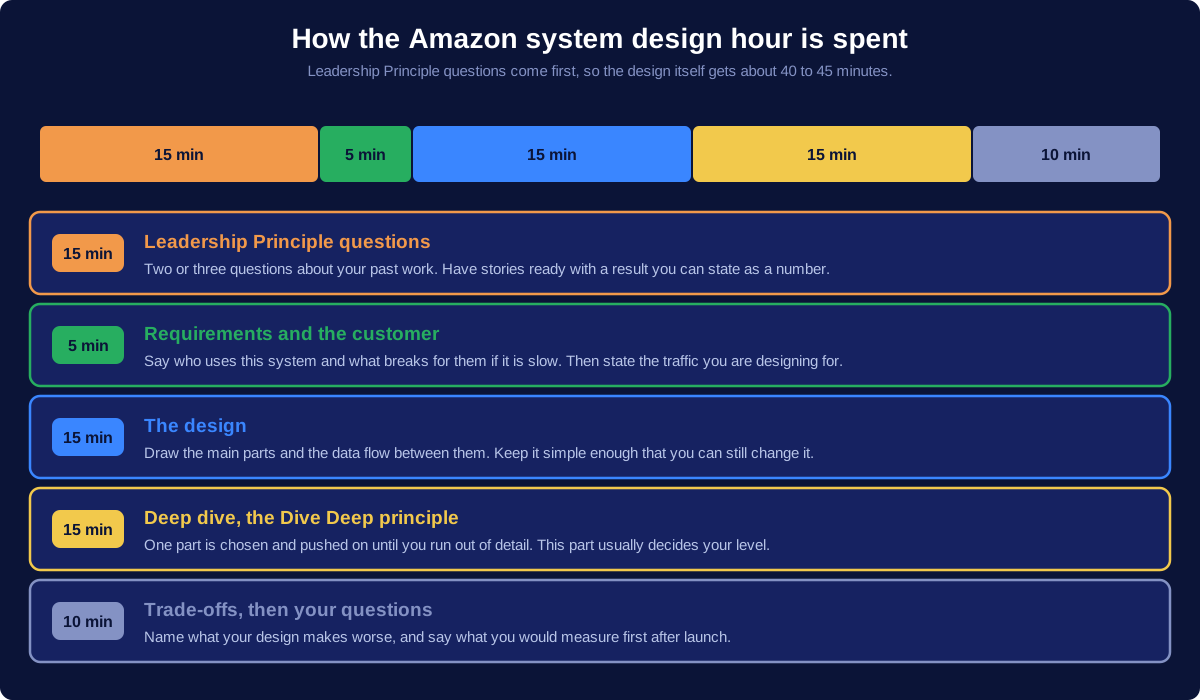
The first 10 to 15 minutes are behavioral. Have two or three stories ready in advance, each with a result you can state as a number. Rambling here does not just cost you the behavioral score. It costs you design time.
The next five minutes are requirements. Ask what the system must do, who uses it, and how much traffic it carries. This is where Customer Obsession is visible, and it is the part candidates skip when they are already behind on time.
The deep dive usually decides your level. The interviewer chooses one part of your design and pushes on it. Have one part of every practice design that you can defend for ten minutes.
What changes by level
| Level | Title | What separates a pass from a fail |
|---|---|---|
| L4 | SDE I | Often low level design. A correct, working design explained clearly |
| L5 | SDE II | Either kind. Trade-offs chosen out loud, and one part designed in real depth |
| L6 | Senior SDE | High level design. Constraints you set yourself, failure handling, cost reasoning |
| L7 | Principal SDE | Ambiguous problems, several systems, and the organizational cost of your choices |
The step from L4 to L5 is the step from describing to deciding. At L5 the interviewer wants to hear you reject an option and say why. At L6 they want you to name the hard part of the problem before they point at it.
Amazon also uses these levels in the offer, so the level you are assessed at determines your compensation band. If you are unsure which level you are interviewing for, ask the recruiter directly.
The questions Amazon asks most often
Amazon design questions tend to come from its own business: ordering, inventory, storage, delivery, and recommendations. Reservation problems appear often, because holding a limited item for a customer without selling it twice is a real Amazon problem.
These free lessons cover the closest published versions of each:
- Designing Ticketmaster, the reservation and inventory problem, the closest match to Amazon ordering questions
- Designing Uber backend, for matching, dispatch, and delivery logistics
- Designing Dropbox, for object storage and file synchronization
- Designing a notification system, for order updates and delivery alerts
- Designing an API rate limiter, which appears at Amazon more than at most companies
- Designing Yelp or nearby friends, for location search and warehouse proximity questions
Learn the reservation problem properly before the others. Holding inventory, releasing it when a customer abandons a cart, and never selling the last item twice is the trade-off Amazon interviewers return to most.
The building blocks underneath those questions are worth studying on their own: caching, sharding, replication, message queues, and the CAP theorem.
If you want the case studies and the trade-off practice in one place, that is what Grokking the System Design Interview is built for. It contains 83 lessons and 15 full design problems, including Ticketmaster, Uber, and Dropbox.
What to practice, in order
Write three Leadership Principle stories with numbers in them. Pick a project you owned, a disagreement you resolved, and a problem you found by digging into data. Each needs a result you can state as a number. This is the cheapest score available in an Amazon loop and it is the part engineers prepare last.
Rehearse the handover. Practice moving from a behavioral answer into the design question without losing your place. Set a timer for 15 minutes of behavioral questions, then start designing immediately.
Practice one deep dive per problem. Choose one part of your design and prepare to defend it for ten minutes. Know the data structure, the failure case, and the option you rejected.
Practice the reservation problem specifically. Take Ticketmaster, then change it: reserve a warehouse item, reserve a delivery slot, reserve a seat. The same trade-off appears in each, and Amazon uses all three shapes.
Prepare for both kinds of design round. If your team may ask low level design, spend a weekend on class design for a parking lot and a vending machine. It is a small amount of work against a real chance of being asked.
Frequently asked questions
How long is the Amazon system design interview? About an hour. The first 10 to 15 minutes are usually Leadership Principle questions about your past work. That leaves roughly 40 to 45 minutes for the design itself.
Does every Amazon candidate get a system design round? No. SDE I loops often replace it with a low level design round, and some teams skip it entirely. SDE II and above almost always have one. Ask your recruiter which rounds are scheduled.
Can the Bar Raiser really reject me on their own? They can block a hire even when the whole loop wants you, and they chair the debrief. They cannot force a hire that the hiring manager opposes. In practice the block is used rarely.
Does Amazon ask low level design or high level design? Both, and which one you get depends on the level and the team. Junior loops lean toward class design, senior loops toward service design, and SDE II can get either.
Do Leadership Principles matter in a technical round? Yes. Every interviewer is assigned principles to assess, including the one running your design round. A strong design with no evidence of ownership or depth still produces a mixed debrief.
What is the most common reason candidates fail this round? Running out of time. The behavioral opening takes longer than expected, requirements get skipped, and the deep dive arrives with nothing prepared behind it.
Related reading
- The Meta System Design Interview, for how a company without Leadership Principles runs the same round
- The Google System Design Interview, for the version of this round where a hiring committee decides
- The Microsoft System Design Interview, for the hour-long round built from the hiring team's own problems
- System Design vs Object Oriented Design Interviews, because Amazon may ask either
- Grokking Low Level Design and OOD: which course covers what, if your loop includes a class design round
- Top 30 System Design Interview Questions and Answers
- System Design Interview Prep When You Have Never Built a Distributed System
- A Beginner's Guide to System Design Interviews, if this is your first design round
Preparing for a specific company is worth doing last, not first. Learn the building blocks, learn one repeatable method, then adjust for the reservation and inventory problems Amazon prefers. Write your Leadership Principle stories before any of it. If you want that structure with the case studies already written, start with Grokking the System Design Interview.