
Codemia is a practice platform for system design interviews. You pick a problem, write your design into a fixed eleven-section template, and an AI model scores what you wrote. The site lists more than 120 system design problems, plus separate sets for coding, object-oriented design, and AI agent design. This review covers what Codemia does well, where it falls short, what it costs, and how it fits next to a course.
Disclosure: I built Grokking the System Design Interview, so I am not neutral about the comparison at the end of this review. I have tried to describe Codemia accurately, including the parts where it is better than my course.
The short verdict: Codemia is good at one job, which is making you produce designs on your own and get fast feedback on them. It is not built to teach you the concepts in the first place. Grokking is the opposite kind of product. It is a course that teaches the concepts and a repeatable method, then walks through full designs with the reasoning written out.
So "which is better" is the wrong question. The right question is which job you need done right now. If you cannot yet explain sharding or a cache eviction policy, no amount of practice attempts will fix that. If you know the material but freeze when asked to produce a design alone, more reading will not fix that either.
What Codemia actually is
Codemia is a practice site for interview problems. Its own comparison is LeetCode, but for system design instead of coding. The site lists more than 120 system design problems, plus separate problem sets for coding, object-oriented design, and AI agent design.
Every system design problem uses the same fixed template. You write your answer into eleven sections, one at a time: functional requirements, non-functional requirements, capacity estimation, API design, database design, high-level design, request flows, detailed component design, trade-offs, failure scenarios, and future improvements. There is a drawing area for diagrams.
When you submit, an AI model evaluates what you wrote and returns feedback. You can then read an editorial solution and solutions posted by other users. The platform also offers peer mock interviews and spaced-repetition flashcards. Spaced repetition means the site re-shows you material at growing intervals so you keep it in memory.
Some problems are free. Full access is a subscription. The list price is $119 a year, and the site usually shows a discount that brings it near $69 a year.
What Grokking the System Design Interview actually is
Grokking the System Design Interview is a structured course on Design Gurus. It has 83 lessons in 5 chapters and takes about 20 hours to complete.
The course teaches in a fixed order. First the building blocks: caching, sharding, replication, load balancing, queues, and the other parts every design uses. Then a chapter on trade-offs, which is the skill interviewers actually score. Then 15 full design problems, including Ticketmaster, Uber, YouTube, and Dropbox, each worked through step by step with the reasoning explained. There are 237 quizzes spread across the lessons.
The difference in teaching style matters. Codemia shows you a finished editorial solution after you attempt a problem. Grokking explains why each choice was made while the design is being built, including the options that were rejected.
Grokking costs about $59 one time, with lifetime access. It holds a 4.7 rating from more than 60,000 learners.
At a glance
| Codemia | Grokking the System Design Interview | |
|---|---|---|
| Kind of product | Practice platform | Course |
| Core activity | You write a design, AI scores it | You learn a method and worked designs |
| System design problems | 120+ practice problems | 15 full case studies, explained |
| Teaching material | Editorial solutions after attempts | 83 lessons, concepts before problems |
| Feedback | AI evaluation per submission | 237 quizzes, self-checked |
| Mock interviews | Peer matching | Not included |
| Price | About $69 a year, subscription | About $59 one time, lifetime |
Where Codemia is genuinely better
Volume of practice. More than 120 problems is far more than any course walks through. If you have four weeks left and want daily repetitions, that library is the point.
It forces output. Reading a solution feels like progress but is passive. Codemia makes you write every section yourself before you see any answer. That discomfort is exactly what an interview tests.
Feedback exists at all. Practicing alone usually means no feedback. An AI review that catches a missing estimation section, or an API with no error cases, is better than nothing and arrives in seconds.
One subscription covers several rounds. Coding, object-oriented design, and system design problems sit in one place, which suits a full loop.
Where Grokking is genuinely better
It teaches, rather than tests. Codemia assumes you already know what a consistent hash ring or a write-ahead log is. Grokking assumes you do not, and defines each part before using it. If your gap is knowledge, start here.
The reasoning is the content. An editorial solution shows the final answer. It rarely shows the three designs that were considered and dropped. Interviews score the choosing, not the answer, and the choosing is what Grokking writes out.
A method you can repeat. The course uses one sequence for every problem. Requirements, estimation, interfaces, data model, high-level design, detail, and bottlenecks. Walking into any question with a practiced sequence beats having seen a similar question once.
One payment. A subscription meters your preparation time. A one-time purchase does not, and interview preparation often repeats a year or two later.
A note on AI feedback
AI evaluation is genuinely useful for structure. It notices a skipped section, a missing scale number, or an API with no failure handling. That covers many of the mistakes beginners make.
It is weaker at judging judgment. Whether your consistency trade-off actually fits the requirements you stated is a harder call, and automated feedback can score a fluent wrong answer well. Treat the score as a checklist result, not as an interviewer's verdict. A human mock, with a peer or a colleague, is still the closest test to the real round.
The order that works: learn first, then drill
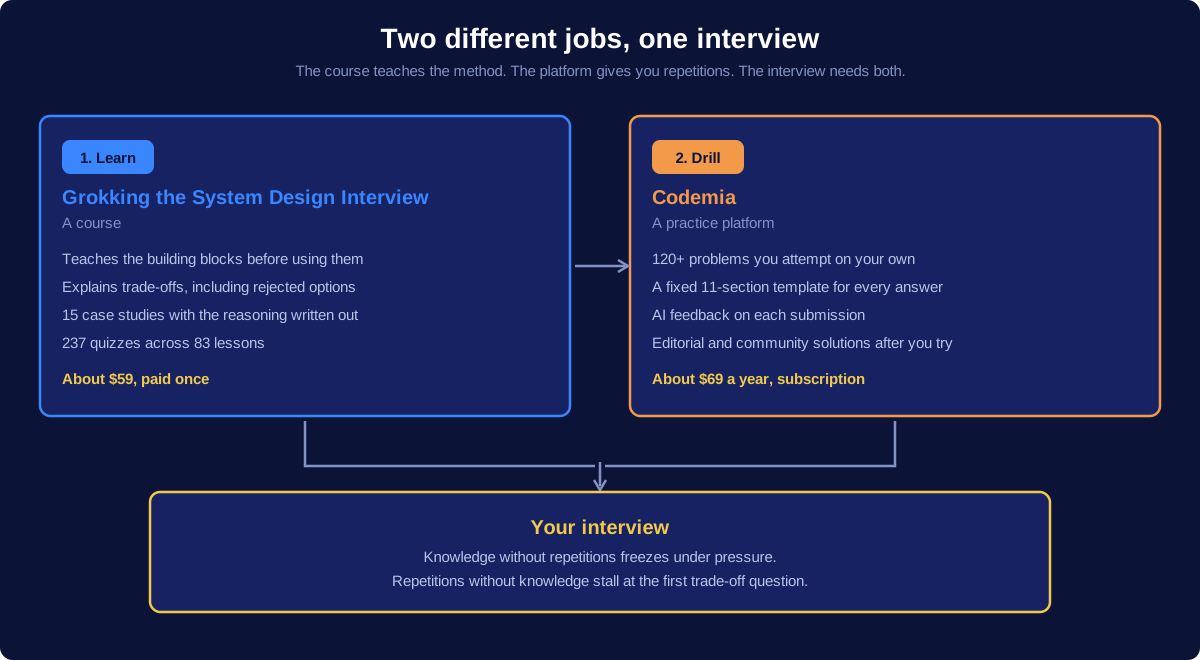
These two products fit into different weeks of the same preparation.
- Learn the building blocks and the method. Work through the course lessons and the trade-offs chapter. This is where the vocabulary and the reasoning come from.
- Study the worked case studies. Read how a full design is assembled, including the rejected options. Fifteen problems, understood deeply, cover most interview questions by analogy.
- Drill on your own. Now a practice platform earns its price. Write designs unaided, take the AI feedback, and compare against editorials.
- Finish with human mocks. One or two timed sessions with a person, before the real loop.
If your budget covers only one product, choose by your gap. Weak on concepts, take the course. Strong on concepts but unpracticed at producing designs alone, take the platform. You can also drill without paying at all: the free system design lessons on Design Gurus include full case studies such as designing YouTube and designing Uber, and you can practice by writing your design before reading each one.
Frequently asked questions
Is Codemia worth it?
For practice, yes, if you already know the building blocks. The fixed template and AI feedback make it easy to attempt many problems quickly. If you cannot yet explain sharding, caching, or replication, learn those first, because practice attempts will not teach them.
Is Codemia a course? No. It is a practice platform. It gives you problems, a fixed answer template, AI feedback, and editorial solutions. It does not teach the underlying material in a structured sequence.
Is Codemia free? Partly. Some problems and their editorial solutions are free. The full problem bank and AI feedback require a subscription, listed at $119 a year and usually discounted to about $69.
Is Codemia enough on its own? If you already know the building blocks, it can be. If you cannot yet explain replication, sharding, or cache invalidation, practice attempts alone will be slow and frustrating. Learn first, then drill.
Is Grokking the System Design Interview enough on its own? It covers the knowledge and the method, and its 15 case studies cover most question types by analogy. What it does not give you is unaided repetitions. Add self-practice or mocks in your final weeks.
Which should I buy first? The course, in most cases. Practice platforms multiply what you already know. The course is also the cheaper of the two at about $59 one time.
How is Codemia different from LeetCode? LeetCode is built around coding problems with automatic test cases. Codemia applies the same drill format to system design, where answers are written text and diagrams, so it uses AI evaluation instead of test cases.
Related reading
- Grokking the System Design Interview Review: Is It Worth It?
- Grokking the System Design Interview vs Hello Interview
- Grokking the System Design Interview vs ByteByteGo
- Is There a Free Version of Grokking the System Design Interview?
- Top 30 System Design Interview Questions and Answers
The honest summary: Codemia and Grokking compete for your budget, not for the same job. One teaches, one drills, and the interview needs both to have happened. If you are starting from unclear fundamentals, start with Grokking the System Design Interview, then add unaided practice in whatever form fits your budget.