
TL;DR: Grokking the Object-Oriented Design Interview is the Design Gurus course for the OOD round, the interview many companies now call low-level design (LLD). It grounds you in object-oriented fundamentals and UML, then works through 22 classic design problems (parking lot, elevator, library, movie booking, and more) with Python, Java, and C++ code. It is a beginner-friendly, design-first course: 35 lessons, in-browser coding playgrounds, studied by nearly 60,000 engineers. It is worth it if your loop has an OOD, LLD, or machine-coding round and you have never designed a class model under interview pressure. It is skippable if you already design object models daily and just need reps.
An engineer emailed me after a rough onsite. They had spent six weeks on distributed systems, walked into their "design round," and were asked to design a parking lot. Classes, relationships, extensibility, not a load balancer in sight. They had prepared hard for the wrong round.
That mix-up is common because the word "design" covers two different interviews, and this course is prep for the one people trip over most. This post is the honest breakdown: what Grokking the Object-Oriented Design Interview actually teaches, the problems it works through, who should take it, and whether it is worth your money and time.
First, a naming note: OOD and LLD are the same round
If you searched for "grokking LLD" or "grokking low-level design" and landed on a course titled object-oriented design, you are in the right place. Object-oriented design (OOD) and low-level design (LLD) are two names for the same interview. Some companies also fold in a machine coding round, where you write compilable classes for the same kind of prompt. The terminology varies by region and company; the skill does not.
That round is different from the system design (high-level design) round in altitude. System design is "design Twitter" at the level of services, databases, and queues. OOD/LLD is "design a parking lot" at the level of classes, interfaces, and how they relate. I wrote a full breakdown of the two rounds in System Design vs Object-Oriented Design Interviews; if you are not sure which one is on your loop, read that first, then come back.
This course is prep for the OOD/LLD side.
What the course actually covers
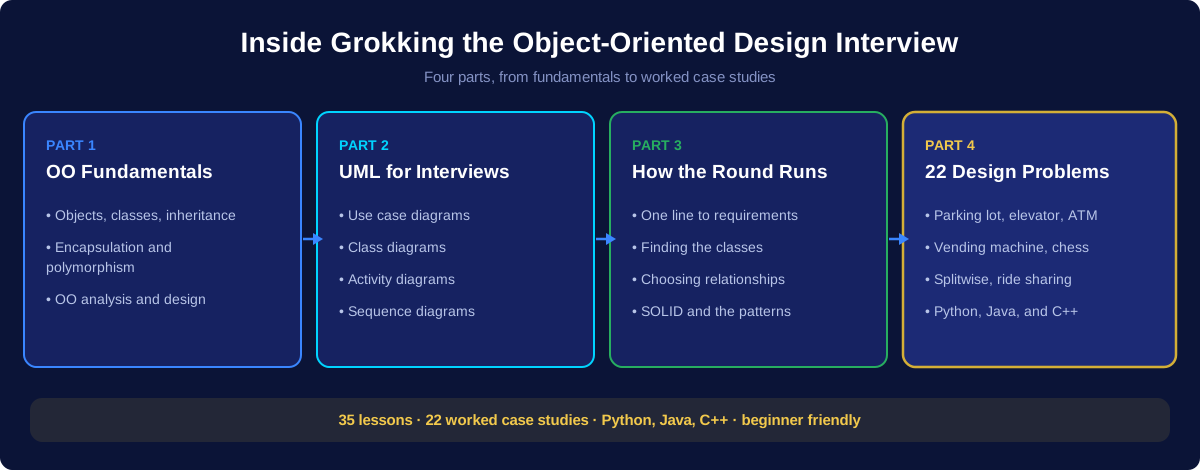
The course is built in three chapters that move from fundamentals to worked problems.
| Attribute | Detail |
|---|---|
| What it teaches | OO fundamentals, UML, how the round runs, and 22 worked OOD/LLD case studies |
| Format | 35 text lessons, plus in-browser coding playgrounds |
| Languages | Code examples in Python, Java, and C++ |
| Length | Self-paced |
| Level | Beginner; basic programming is the only real assumption |
| Learners | Nearly 60,000 engineers |
| Price | $30 one-time for lifetime access (also included in the all-course subscription) |
Chapter 1: object-oriented fundamentals
The first chapter makes sure the vocabulary is solid before you design anything: objects and classes, the four pillars (encapsulation, abstraction, inheritance, polymorphism), and object-oriented analysis and design, the process of turning a written prompt into classes and responsibilities. This is the part that beginners skip and then fumble in the room, because interviewers listen for whether you reason in objects or just start typing.
Chapter 2: the UML interviewers expect
The second chapter covers the diagrams you actually draw in an OOD interview: use case diagrams to capture what the system does, class diagrams to show structure and relationships, and activity and sequence diagrams to show behavior over time. You do not need to be a UML purist to pass, but being able to sketch a clean class diagram quickly is one of the clearest signals you can send.
How the round itself runs
A newer block of six lessons sits between the UML material and the case studies, and it covers the round rather than the theory: how the interview runs, turning one line into a list of requirements, finding the classes, choosing the relationship between two classes, keeping the design honest with SOLID, and the design patterns that come up in this round. This is the part that turns knowledge of objects into a repeatable method under time pressure.
The case studies, worked end to end
The heart of the course is 22 case studies, each taken from requirements to a class design, with code in Python, Java, and C++. Code is not the point of the course; the design is. The playgrounds are there so you can see the object model expressed in a real language rather than treating it as an abstract diagram.
The 22 design problems
These are the classic OOD/LLD interview questions, and working several of them is the fastest way to stop freezing on the format:
- Parking Lot
- Library Management System
- ATM
- Elevator System
- Vending Machine
- Movie Ticket Booking
- Hotel Management
- Car Rental System
- Restaurant Management
- Airline Management
- Blackjack and a Deck of Cards
- Chess
- Stack Overflow
- Cricinfo
- Amazon (online shopping)
- Stock Brokerage
- Splitwise
- Notification Service
- In-Memory Cache
- Ride Sharing Service
They are ordered roughly from simplest to hardest, so the early ones teach the method and the later ones test it. The value is not memorizing 22 answers. It is that after four or five of them you start to see the moves that repeat: find the nouns, turn them into classes, assign each class one clear responsibility, model the relationships, then extend for the follow-up. That transfer is what carries you through a problem you have never seen.
Who it is for, and who can skip it
Take it if you have an OOD, LLD, or machine-coding round coming up and you have never designed a class model against the clock, or you can code fine but go blank when asked to structure a system into classes. Beginners and career-switchers get the most out of it because it starts at fundamentals and does not assume prior design experience.
You can probably skip it if you already design object models every day, know your UML, and just want reps. In that case, practice a handful of the problems above on your own and spend your prep time elsewhere. Also note the deliberate scope: this is a design course, not a Gang-of-Four design-patterns catalog and not an algorithms course. If your round is really about data structures and complexity, that is a different kind of prep.
Is it worth it?
For the audience above, yes, mostly because of what it prevents. The OOD/LLD round is one of the most format-sensitive interviews there is: strong engineers fail it not for lack of ability but because they have never practiced turning a vague prompt into classes in 45 minutes. A structured pass through fundamentals, UML, and a dozen worked problems removes that specific failure mode, which is exactly the kind of avoidable loss that is worth a small, one-time cost.
On price, it is a one-time $30 for lifetime access, not a subscription trap, and it is also included if you have the DesignGurus all-course subscription. If your loop has both a system design and an OOD round, the subscription is usually the better math, since it bundles this with Grokking the System Design Interview and the rest of the catalog.
The honest caveat: the course stays at the design layer on purpose. If you want deep Gang-of-Four pattern theory or heavy machine-coding drills with automated grading, treat this as the foundation it is, not the whole of your prep.
Where it fits with the other Grokking courses
People searching this course name usually have one real question: which Design Gurus course do I actually need? Here is the short map.
| If your interview is about... | Take |
|---|---|
| Architecture of a large system (HLD) | Grokking the System Design Interview |
| Class-level design (OOD / LLD) | Grokking the Object-Oriented Design Interview |
| Both rounds on one loop | Both, prepped separately |
If you want the full lay of the land, every Grokking course explained walks through the whole catalog and where each one fits.
Frequently asked questions
Is Grokking the Object-Oriented Design Interview the same as LLD prep? Yes. Object-oriented design (OOD) and low-level design (LLD) are two names for the same round. The course is prep for it, whatever your company calls it.
Does it teach SOLID and design patterns? It teaches object-oriented fundamentals and applies clean design across 22 case studies, so you practice good structure throughout. It is not a dedicated Gang-of-Four patterns course, though. If you specifically want a catalog of design patterns, that is a separate topic.
Is it in Java or Python? Both. Each design problem includes code examples in Java and Python. That said, code is not the emphasis; the object model and the reasoning are.
Is this course enough to pass an OOD interview? For most candidates, the fundamentals plus several worked problems are enough to walk in confident and structured. As with any prep, the people who pass are the ones who actually practice the problems out loud, not just read them.
Is there a book or PDF version? No. It is an interactive course with text lessons and coding playgrounds, not a downloadable book. Search results promising a "PDF" are usually pirated or out of date.
Do I need it if I already know OOP? Maybe not. If you design class models regularly and know your UML, you may only need reps. The course is aimed at engineers who can code but have never designed a system into classes under interview pressure.
Related reading
- System Design vs Object-Oriented Design Interviews. How to tell which round is on your loop, HLD vs LLD.
- Grokking low level design and OOD. Which course covers object-oriented design, patterns, and concurrency.
- Grokking the Low Level Design Interview Using OOD Principles. The similarly named Educative course, compared side by side with this one.
- Every Grokking Course Explained. The full catalog and which course fits which interview.
- Grokking the System Design Interview Review. The honest founder review of the HLD course.
- System Design Fundamentals vs Grokking the System Design Interview. Which system design course to open first.
Start with one problem
The fastest way to know if this round is your weak spot is to try one problem cold. Open the course, design the parking lot before you read the solution, then compare. Thirty minutes will tell you exactly how much prep you need.