
Disclosure: I run Design Gurus, which publishes a course with a very similar name to the one this page is mostly about. I have an obvious interest in which one you choose. So this page reports what is in each course and lets you decide. It does not rate the quality of the one I did not build.
Grokking the Low Level Design Interview Using OOD Principles is published by Educative. It is not on DesignGurus.io, and it is not the same course as Grokking the Object Oriented Design Interview, which is mine. If you searched for one and landed on the other, the names are close enough that this happens constantly.
This page describes what is inside the Educative course, how it is sold, and how it differs from the similarly named course on Design Gurus. Both are real, both cover the low level design round, and they are built differently enough that the choice is a genuine one.
What is inside the Educative course
| At a glance | |
|---|---|
| Publisher | Educative |
| Lessons | 215, across 28 sections |
| Study time | About 70 hours |
| Case studies | 21 design problems |
| Mock interviews | 19 |
| Languages | Java, Python, C++, C#, and JavaScript |
| Sold as | Part of an Educative subscription |
The first six sections teach the material before any case study: object-oriented programming basics, object-oriented design, design principles, and design patterns. The remaining sections are worked design problems, one per section.
The 21 problems are these:
| Parking Lot | Elevator System | Library Management |
| Amazon Locker Service | Vending Machine | Online Blackjack |
| Meeting Scheduler | Movie Ticket Booking | Car Rental System |
| ATM | Chess | Hotel Management |
| Amazon Online Shopping | Stack Overflow | Restaurant Management |
| Online Stock Brokerage | Jigsaw Puzzle | |
| Airline Management | ESPNcricinfo |
Five languages is unusual for this kind of course, and it is the clearest thing the Educative version has that mine does not. If you interview in C# or JavaScript, that matters.
Why two courses have almost the same name
This is the second time the naming has collided. Educative also publishes Grokking Modern System Design Interview alongside my Grokking the System Design Interview, and readers confuse those two just as often. The history behind the shared branding is here.
The short version is that both companies use the Grokking name for interview preparation courses. Neither title is a variation of the other in a way a reader can be expected to notice. Both describe the same interview round, using the two names that round goes by.
If you bought one expecting the other, you did not miss something obvious. Check the domain in your receipt: educative.io or designgurus.io.
How each one is sold
This is the practical difference, and it is worth knowing before you start comparing content.
The Educative course is part of an Educative subscription. You subscribe to the platform and the course is included, along with the rest of the catalog. Access lasts as long as the subscription does.
Grokking the Object Oriented Design Interview is a one-time purchase of $30 with lifetime access. You buy the course and keep it, with no recurring payment.
Neither model is better in general. A subscription is cheaper if you plan to work through several courses in a few months. A one-time purchase is cheaper if you want one course and expect to come back to it before a future interview.
The other course: Grokking the Object Oriented Design Interview
Mine, on DesignGurus.io. It is built around 22 case studies rather than a broad curriculum.
The lessons before the case studies do two things. Seven cover object-oriented basics and UML, which is the notation for drawing class diagrams. Six more cover how the round itself runs:
- Turning one line into a list of requirements
- Finding the classes
- Choosing the relationship between two classes
- Keeping the design honest with SOLID
- The design patterns that come up in this round
The 22 case studies are these:
| Parking Lot | Library Management | ATM |
| Elevator System | Vending Machine | Movie Ticket Booking |
| Hotel Management | Car Rental System | Restaurant Management |
| Airline Management | Blackjack and a Deck of Cards | Chess |
| Stack Overflow | Cricinfo | |
| Amazon Online Shopping | Online Stock Brokerage | |
| Splitwise | Notification Service | In-Memory Cache |
| Ride Sharing Service |
They run roughly from simplest to hardest. Each one goes from requirements through a class diagram to working code in Python, Java, and C++.
There is a fuller walkthrough of it in this post.
Where mine is thinner, stated plainly. It is much smaller overall, 35 lessons against 215, so there is far less teaching material around the problems. It covers three languages instead of five, and it includes no mock interviews. It also does not cover concurrency, which appears often in machine coding rounds, and that material sits in a separate course rather than this one. I would rather it did not.
Side by side
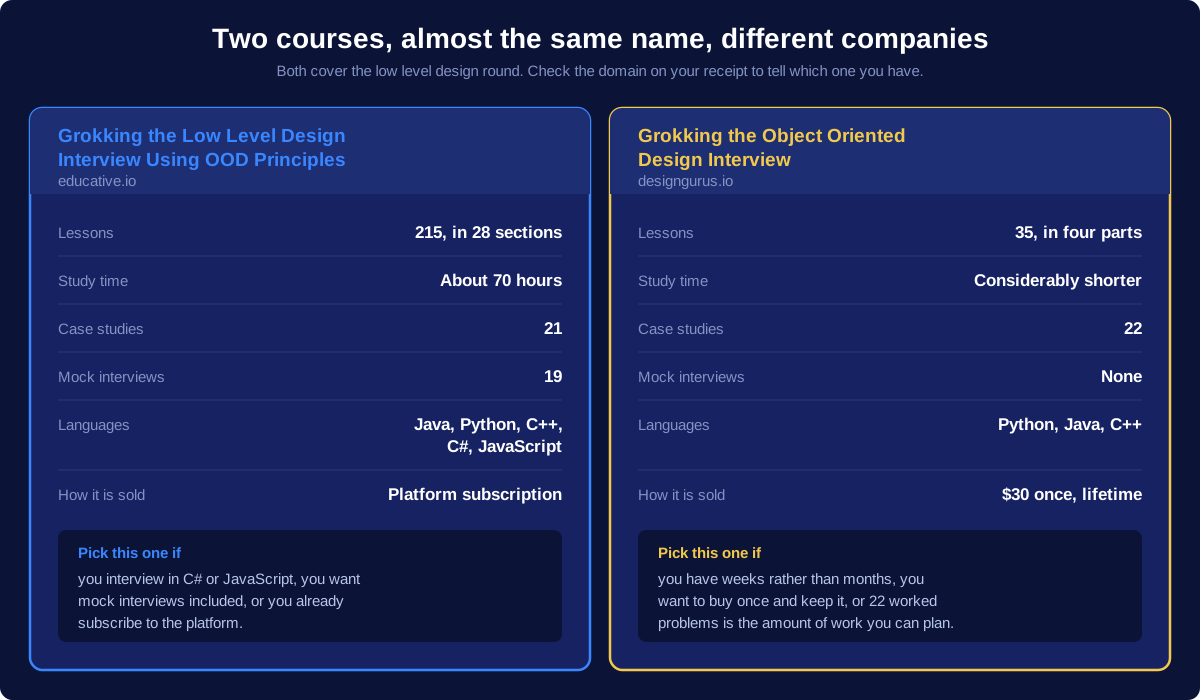
| Educative course | Design Gurus course | |
|---|---|---|
| Full name | Grokking the Low Level Design Interview Using OOD Principles | Grokking the Object Oriented Design Interview |
| Publisher | Educative | Design Gurus |
| Lessons | 215 across 28 sections | 35, in four parts |
| Study time | About 70 hours | Considerably shorter |
| Case studies | 21 | 22 |
| Languages | Java, Python, C++, C#, JavaScript | Python, Java, C++ |
| Mock interviews | 19 | None |
| How it is sold | Platform subscription | $30 once, lifetime access |
| Concurrency | Not the focus | Not included, sits in a separate course |
The overlap in case studies is large. Eighteen problems appear in both courses. That is not a coincidence and it is not copying in either direction. These are the problems the industry actually asks, and any serious course on this round covers most of them.
The differences are at the edges. The Educative course has three that mine does not: Amazon Locker Service, Meeting Scheduler, and Jigsaw Puzzle. Mine has four that it does not: Splitwise, a notification service, an in-memory cache, and a ride sharing service. Those four lean closer to the service-shaped problems that appear in senior loops.
Which one fits which person
| Your situation | The better fit |
|---|---|
| You interview in C# or JavaScript | The Educative course. Mine does not cover those languages |
| You want mock interview practice included | The Educative course |
| You have weeks, not months, before the round | Mine. Twenty-two worked problems is a plannable amount of work |
| You want to buy once and keep it | Mine, at $30 with lifetime access |
| You already subscribe to Educative | The Educative course. You have it already |
| You need concurrency for a machine coding round | Neither one alone. Add a concurrency course to whichever you pick |
| You design classes daily at work and want reps | Neither. Work through parking lot, elevator, and chess on paper, then check yourself |
That last row is genuine. Engineers who model objects every day usually need practice under time pressure rather than instruction.
Is there a PDF or a free copy
No official PDF exists for either course. Both are interactive platforms with code you run in the browser, and that is most of what an object-oriented design course is for.
Copies circulating on file sharing sites are text extracts, usually years out of date, and they exclude the code environments entirely. More on where the PDF searches lead.
Frequently asked questions
Who publishes Grokking the Low Level Design Interview Using OOD Principles? Educative publishes it, at educative.io. It is not a Design Gurus course. Design Gurus publishes Grokking the Object Oriented Design Interview, which covers the same interview round under the other common name for it.
Is it the same as Grokking the Object Oriented Design Interview? No. They are separate courses from separate companies, covering the same round. The Educative course is larger overall, at 215 lessons across 28 sections. Mine is 35 lessons built around 22 case studies, so it is shorter but has one more worked problem.
What is the difference between LLD and OOD? In interview practice, almost nothing. LLD, meaning low level design, is the more common term in India. OOD, meaning object-oriented design, is standard in US job postings. Both describe a round where you design the classes inside one system.
Can I buy the Educative course on its own? Educative sells access through a platform subscription rather than as single lifetime purchases. Check the course page for the current options, since platform pricing changes.
Which one do interviewers expect me to have taken? Neither. No interviewer asks which course you used. They ask you to design a system in classes, and both courses prepare you for that.
Do I need design patterns for this round? You need enough to reach for the right one and justify it. Factory, strategy, observer, decorator, singleton, adapter, and builder cover most of what appears. Reciting all 23 Gang of Four patterns is not useful.
Is low level design the same as system design? No. System design is the high-level round about scaling a service across machines. Low level design is about the classes inside one service. The full comparison is here.
Related reading
- Grokking Low Level Design and OOD: which course covers what. The full map, including the patterns and concurrency courses.
- Grokking the Object-Oriented Design Interview: what it covers and is it worth it. The Design Gurus course in detail.
- Grokking Modern System Design Interview vs the original. The other case of two courses sharing a name.
- System design vs object-oriented design interviews. Which round you are actually preparing for.
- Every Grokking course explained. The full catalog map.
- The Amazon System Design Interview. Amazon is the large company most likely to ask low level design.
Before buying anything, take one problem and design it on paper for 30 minutes. Parking lot is the standard opener. Write the classes, their responsibilities, and their relationships, then add one new requirement and see whether your design absorbs it. That tells you more about your readiness than any course description, including this one.
See Grokking the Object Oriented Design Interview · Read the free system design lessons