
Disclosure, and it matters more on this page than most: I built the course this page is mostly about, and I sell it. An earlier version of this page said no such course existed and pointed readers at competitors instead, which was true when I wrote it. It launched, so this page changed. I have kept the parts where other people's material is the better answer, and I have been specific about what this course does not do.
If you searched for "Grokking ML system design" or "Grokking AI system design", there is now a direct answer: Grokking the AI System Design Interview, 70 lessons across 9 modules.
This page covers what is in it, which interview it prepares you for, where other resources still fit better, and which of the similarly named courses belongs to whom, because that last question causes real confusion.
The short answer
| What you searched for | What it is |
|---|---|
| Grokking AI System Design | Grokking the AI System Design Interview, mine, 70 lessons |
| Grokking ML System Design | The same course. Modules 2 and 3 are the classic ML design material |
| Grokking the Machine Learning Interview | Educative's course, separately authored from mine |
| Grokking the Generative AI System Design | Also Educative's, separately authored |
| AI infrastructure inside a general system design round | The AI chapter of System Design Patterns, or module 8 of the AI course |
| AI fundamentals, not interview-shaped | Grokking Modern AI Fundamentals |
The Grokking name appears on courses from two different companies. Educative publishes several; I publish several others. The overlap is historical and it confuses people constantly. The full explanation is here.
Grokking the AI System Design Interview
| At a glance | |
|---|---|
| Lessons | 70, across 9 modules |
| Study time | About 20 hours |
| Assessments | 540 |
| Price | About $49 (60 percent off the $123 list price), one payment, lifetime access |
| Rating | 4.8 out of 5, from 61 ratings |
| Learners | 1,192 |
| Built for | Software, ML, and data engineers, junior through senior |
| Assumes | No machine learning background and no research experience |
| Home | DesignGurus.io |
The nine modules:
- The AI Interview Landscape. What these rounds actually test and how they differ from a general system design round.
- ML Systems Foundations. Production machine learning: data, features, training, serving, evaluation, and drift.
- Classic ML Design Questions. Recommendation systems, feed ranking, search, ads, and fraud detection.
- LLM Serving and Inference. The economics and mechanics of putting a large model behind an API.
- RAG and Retrieval. Retrieval-augmented generation, embeddings, and grounding answers in your own data.
- GenAI Product Designs. ChatGPT-style assistants and the products built on top of foundation models.
- Agentic Systems. Tool use, orchestration, and guardrails.
- System Design Interview Case Studies. Full designs worked end to end.
- Rapid Review. Revision material for the days before an interview.
The scoping decision worth knowing about: the course is explicitly built for engineers who are not machine learning specialists. It assumes no ML background. That is the right call for the audience I actually have, which is backend and infrastructure engineers now being asked AI questions, and it is a real limit if you are an ML specialist looking for depth rather than interview coverage. I will come back to that below.
On the rating: 4.8 from 61 ratings. That is a good number from a small sample, because the course is new. Treat it as weaker evidence than the 60,815 ratings behind the flagship, and weigh the module list above more heavily than the star count.
The three rounds, and which modules cover each
"AI system design interview" describes at least three different rounds. Separating them is the most useful thing on this page, because the preparation differs and the search terms do not.
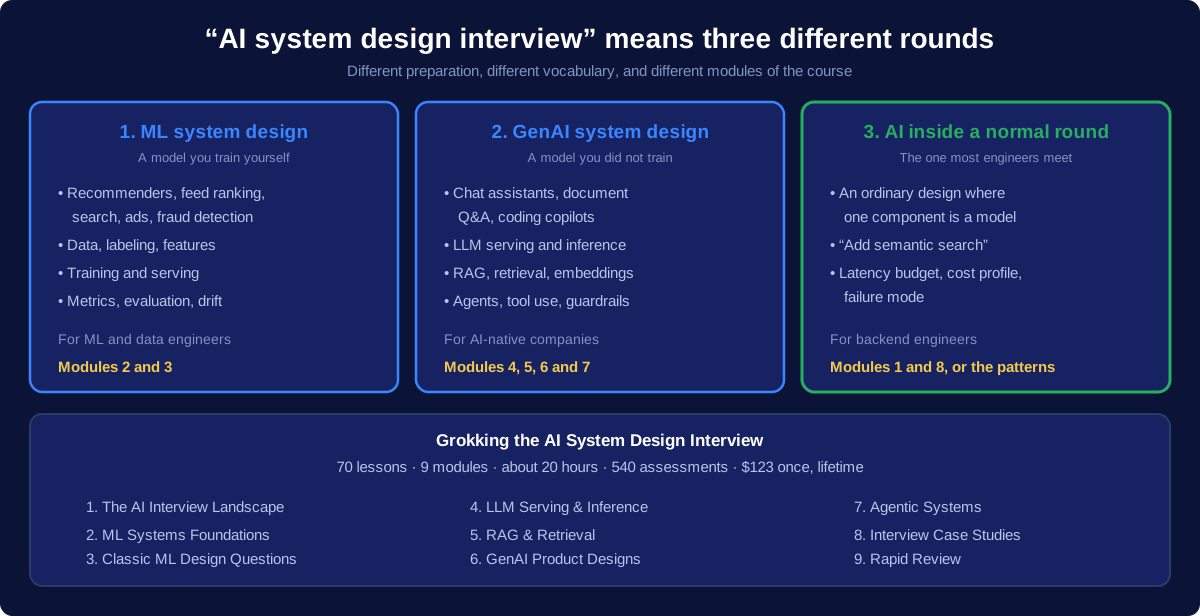
1. The ML system design round. The classic one. Design a recommendation system, a feed ranker, a fraud detector, an ad click predictor. You are expected to talk about problem framing, data collection and labeling, feature engineering, model choice, training and serving infrastructure, online and offline evaluation, and what happens when the model drifts. This round has existed for years at companies with machine learning organizations.
Covered by modules 2 and 3.
2. The generative AI or LLM system design round. Newer, and appearing fastest at AI-native companies and at large companies building on foundation models. Design a chat assistant, a document question-answering system, a coding copilot. The vocabulary is different: retrieval, embeddings, vector stores, context windows, prompt orchestration, guardrails, evaluation without ground truth, inference cost, and latency.
Covered by modules 4, 5, 6, and 7.
3. AI infrastructure inside an ordinary system design round. The one most engineers will actually meet. You are asked to design a normal system and one component turns out to be a model, or the interviewer asks how you would add semantic search to what you just designed. You are not being tested as an ML engineer. You are being tested on whether you can treat a model as an infrastructure component with a latency budget, a cost profile, and a failure mode.
Covered by modules 1 and 8, and by the AI infrastructure chapter of System Design Patterns.
If you are a backend or infrastructure engineer with a general loop ahead, round three is your round and you may not need the whole course. If AI or ML is in the job title, rounds one and two are where your interview will be decided.
The other courses with similar names
Grokking the Machine Learning Interview and Grokking the Generative AI System Design are published by Educative, not by me. The first covers ML fundamentals, the ML system design round, and coding. The second teaches a framework they call SCALED with case studies across text-to-text, text-to-image, text-to-speech, and text-to-video systems.
I am not going to review courses I compete with and have not taught from. I name them because those exact search terms lead to them, and because someone who buys one expecting the other has been failed by the branding rather than by their own carelessness. The same overlap exists in general system design, where Educative publishes Grokking Modern System Design Interview alongside my Grokking the System Design Interview.
The honest distinction I can make without characterizing quality: Educative's ML course assumes you are pursuing machine learning roles. Mine assumes you are not an ML specialist and need to handle AI design questions anyway. If you are an ML engineer with a research background, that difference probably points you at theirs.
What else Design Gurus has in this area
Grokking Modern AI Fundamentals. 50 lessons across 14 chapters, about 5 hours, $29. A grounding in how AI actually works, from core concepts through neural networks, agentic AI, and reinforcement learning. It is not an interview course: no framework, no design case studies, no timed practice. Take it before the AI System Design course if the underlying concepts are unfamiliar, or on its own if understanding rather than interviewing is the goal.
The AI infrastructure chapter of System Design Patterns. Seven patterns treated with costs and failure modes, in the same format as the rest of that course. This is the cheapest way to cover round three if a full AI course is more than you need. All seven are listed free in the pattern reference.
Grokking Prompt Engineering. Prompt engineering for portfolio and job search work. Unrelated to system design interviews, listed because it appears in the same searches.
Which to take, by situation
| Your situation | Take |
|---|---|
| AI or ML design round on the calendar, you are not an ML specialist | Grokking the AI System Design Interview |
| GenAI, LLM, or agentic round specifically | The same course, modules 4 through 7 |
| Backend engineer, general system design round that might touch AI | Grokking the System Design Interview plus the seven AI patterns. The full AI course is more than you need |
| ML engineer with a research background, ML-specialist role | Educative's Grokking the Machine Learning Interview, or ByteByteGo's ML material. Mine is scoped for non-specialists |
| The concepts themselves are unfamiliar | Grokking Modern AI Fundamentals first, then the AI System Design course |
| Senior, and serving infrastructure is the risk | The AI course plus Volume II. Serving a model at scale is a distributed systems problem before it is an ML problem |
| Two weeks and an AI-adjacent round | The seven patterns below, plus modules 1 and 8. Depth on training will not help in that window |
The seven AI infrastructure patterns
These appear in ordinary system design rounds now, whatever your role:
- RAG pipeline. Retrieval plus generation, so model answers are grounded in your own data instead of invented.
- Model serving. Inference behind an API, with latency and versioning guarantees.
- LLM gateway. One control point for routing between models, capping cost, and falling back when a provider fails.
- Semantic caching. Caching answers by meaning rather than exact string match, which is what makes model-backed features affordable.
- Vector database sharding. Scaling similarity search past one machine.
- GPU auto-scaling. Matching scarce, expensive compute to load without paying for idle capacity.
- Feature store. One consistent source of features for training and serving, so the model sees the same data in production that it saw in training.
The interview value is in the costs and failure modes rather than the definitions. Semantic caching is easy to name and interesting to defend: what counts as similar enough, and what happens when the cache returns a confidently wrong answer to a question that only looked like the cached one.
Frequently asked questions
Is there a Grokking AI System Design course?
Yes. Grokking the AI System Design Interview runs 70 lessons across 9 modules, about 20 hours, with 540 assessments, at about $49 for lifetime access. It covers classic ML design, LLM serving, RAG, generative AI products, and agentic systems.
Is there a Grokking ML System Design course?
The same course covers it. Modules 2 and 3 are the machine learning system design material: production ML foundations, then recommendation systems, feed ranking, search, ads, and fraud detection. Separately, Educative publishes Grokking the Machine Learning Interview, which is a different course from a different company.
Do I need a machine learning background to take it?
No. The course is explicitly built for engineers who are not ML specialists and assumes no ML background or research experience. If you are an ML specialist seeking depth rather than interview coverage, a dedicated ML course is a better fit.
Who publishes Grokking the Machine Learning Interview?
Educative. It is not one of my courses, despite the shared Grokking branding. The same overlap exists in general system design and in low level design.
What is the difference between an ML system design and a GenAI system design interview?
ML system design centers on a model you train: data, features, training, evaluation metrics, drift. GenAI system design centers on a model you did not train: retrieval, embeddings, context management, prompt orchestration, guardrails, evaluation without ground truth, and inference cost. Different vocabulary, overlapping infrastructure. The course covers both, in modules 2 and 3 and in modules 4 through 7 respectively.
Does it cover agentic systems?
Yes, module 7: tool use, orchestration, and guardrails. This is the newest part of these interviews and the part most existing resources have not caught up with.
Do I need this if I am a backend engineer with a normal system design round?
Probably not the whole course. What you need is the ability to treat a model as an infrastructure component. The seven AI infrastructure patterns cover that, and they are free on this site. Take the full course if AI design questions are likely rather than possible.
How does it compare to Grokking the System Design Interview?
Different interviews. The flagship prepares you for a general system design round: the six-step framework and 15 classic problems. The AI course prepares you for a round where the system is built around a model. If your loop has both, you need both. If your loop has one, take that one.
Are AI questions appearing in regular system design interviews?
Increasingly, most often as a component within a normal design rather than as the whole question: add semantic search, add a recommendation feature, serve this model at scale.
Is Grokking Modern AI Fundamentals an interview course?
No. It teaches how AI works across 50 lessons and 14 chapters, with no interview framework and no timed practice. It is the on-ramp, not the interview preparation.
Related reading
- System Design Patterns: all 62, plus the 12 that decide interviews. Includes all seven AI infrastructure patterns, free.
- Grokking Modern System Design Interview vs the original. Why two companies publish Grokking-branded courses.
- Every Grokking course explained. The full catalog map.
- Grokking low level design and OOD. The other cluster where the naming overlaps.
- Grokking the System Design Interview Review. An honest review of the general course.
- Hello Interview system design. A platform that also covers ML system design.
Start with the patterns, they transfer
Whatever your role, the AI infrastructure patterns show up in interviews you were already going to have. All seven are free in the pattern reference. If AI design questions are actually on your calendar, the course is the tool built for them.
See Grokking the AI System Design Interview · Read the free pattern reference