Grokking Modern API Design Interview is the Design Gurus course for the API design round, the interview where you are graded on the contract a service offers rather than on how it scales. It teaches one repeatable method, applies it to REST, gRPC, GraphQL and AI product APIs, and then works through 15 complete designs.
The course exists because the API round is graded differently from the system design round, and preparation for one does not fully cover the other. A strong scaling answer earns little credit when the interviewer is checking status codes, error bodies and versioning.
This article explains what the API design interview is, what each chapter of the course teaches, how the method works on a real operation, and who should take the course before the others.
What is an API design interview?
An API (application programming interface) is the set of operations one program offers to another, together with the rules for calling them. In an API design interview, you receive a one-line question, such as "design the API for a payment service", and you produce that set of operations in detail.
The interviewer is grading the contract. That means the resources you expose, the operations on them, the exact fields in each request and response, the status codes and error bodies, and the promises you make to callers about compatibility. A diagram of servers and databases is not the answer this round is looking for.
Some companies run this as a separate round. More often, a system design interview pauses on the contract for ten or fifteen minutes, and the same skills decide that part of the hour.
How is it different from a system design interview?
The two rounds overlap, because every system has an API and every API runs on a system. They still ask different questions, and the table below shows where they part.
| System design interview | API design interview | |
|---|---|---|
| Main question | How does this product scale? | What exactly is the contract? |
| What you draw | Services, databases, caches, queues | Resources, operations, request and response bodies |
| Typical depth | Data flow and bottlenecks | One operation designed field by field |
| Hard parts | Sharding, replication, consistency | Idempotency, rate limits, versioning, errors |
| A common miss | No capacity estimate | No error contract a caller can act on |
If you have prepared only for system design, the gap is usually in the last two rows. Engineers who build APIs every day often have the opposite gap: their designs work in production, but they have never defended one out loud inside 45 minutes.
What is inside Grokking Modern API Design Interview?
The course has eight chapters. Each chapter ends with a chapter assessment, and every lesson is text with diagrams, so you can compare a request against the response it produces without pausing a video.
| Chapter | What you learn |
|---|---|
| 1. The API Design Interview | What the round grades, the six-step method, and a URL shortener API designed end to end |
| 2. Designing a REST API | Resources, HTTP methods, URLs, field types, status codes, pagination, and the Twitter API as a capstone |
| 3. When REST Is Not Enough | gRPC contracts, GraphQL schemas, WebSockets, webhooks, long running work, and large uploads |
| 4. The Hard Parts | Idempotency keys, rate limiting, authorization, versioning, concurrency, caching, and a payment API |
| 5. APIs for AI Products | Streaming responses, APIs that AI agents call, usage billing, and an LLM inference API |
| 6. More Interview Questions | Six further designs, from a chat API to a collaborative document API |
| 7. The Product Architecture Round | Turning a feature into a data model and an API that serves one screen |
| 8. Full Answers and Quick Review | A 10-minute answer, two more designs, a broken API to critique, and red flag cheat sheets |
The examples are HTTP requests, JSON bodies, Protobuf definitions and GraphQL schemas. Protobuf is the format gRPC uses to define messages and services. None of the material depends on a programming language, because a contract is not written in one.
See the full syllabus of Grokking Modern API Design Interview.
The six-step method
Every design in the course follows the same six steps. The steps exist so that you always know what to do next, even on a question you have never seen.
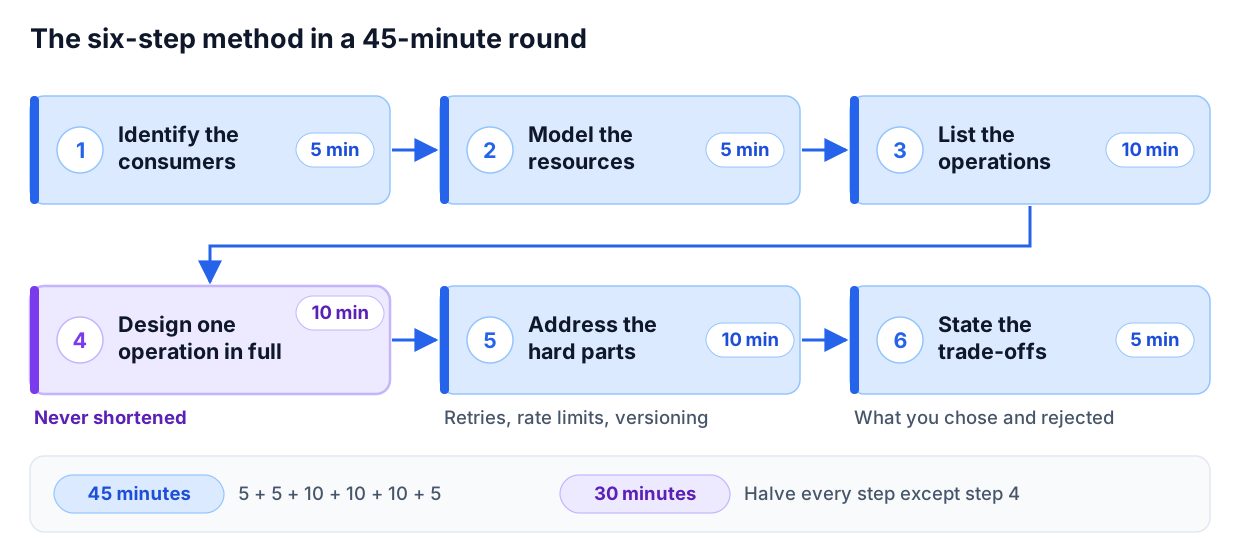
- Identify the consumers. Name who calls the API and the jobs they need to finish.
- Model the resources. Decide which nouns the API exposes, such as a payment or a refund.
- List the operations. Write down every call the consumers need, without detail yet.
- Design one operation completely. Pick the most important call and specify every field, status code and error.
- Address the hard parts. Cover retries, rate limits, authorization and versioning where they apply.
- State the trade-offs. Say what you chose, what you rejected, and why.
The course budgets those steps at 5, 5, 10, 10, 10 and 5 minutes for a 45-minute round. When you only get 30 minutes, every step is halved except the fourth, because one fully designed operation is the evidence the round exists to collect.
What the method looks like on one operation
Take the payment question from earlier. After steps one to three, you have a merchant as the consumer, a payment as the main resource, and a short list of operations. Step four then designs the call that creates a payment.
POST /v1/payments
Idempotency-Key: 8f14e45f-ceea-467a-9b2f-1a2b3c4d5e6f

{ "amount": 4999, "currency": "USD", "source": "card_123" }

201 Created
{ "id": "pay_789", "status": "pending", "amount": 4999, "currency": "USD" }
Two details in that short exchange earn most of the credit. The amount is an integer number of cents, so no rounding error can change it. The Idempotency-Key header is a unique value the client sends with each attempt, so the server can recognize a retry and return the first result instead of charging the card twice.
Step five then asks what happens when the same key arrives with a different body, which status code a declined card returns, and how a caller learns that a pending payment later succeeded. Chapter 4 of the course works through each of those questions and ends by designing the full payment API.
The 15 worked designs
The course takes 15 questions from a one-line brief to a finished contract. Five of them are capstones that close a chapter.
- Capstones: a URL shortener, the Twitter API, a live notification API, a payment API, and an LLM inference API.
- Further questions: a chat API, a booking API, a feature flag API, a checkout API, a calendar API, and a collaborative document API.
- Product architecture questions: the API behind a news feed screen and the API behind a messaging app.
- Final review questions: a ride sharing API and a file storage API.
A separate lesson gives you a deliberately broken API and asks you to critique it. Interviewers use that question type more often than most candidates expect, and it tests whether you can find the defects in a contract you did not write.
Who should take it, and who should start elsewhere
Take this course if you have an API design round or a product architecture round scheduled. It also suits backend and platform engineers whose system design answers are strong on scaling but thin on the contract.
Start with Grokking the System Design Interview if your loop has a general system design round and no separate API round. The API course assumes you can already sketch the services behind an API, and the system design course is where that skill is taught.
Start with System Design Fundamentals if terms such as cache, replica and shard are still new. Both interview courses build on those ideas without stopping to define them in depth.
The full list of Grokking system design courses shows where each course fits, if you are deciding between several.
How to try it before you buy
Two lessons are free to read: the framework lesson, which teaches the six steps in full, and the idempotency keys lesson, which covers the retry problem from the payment example above.
Reading the framework lesson first is the fastest way to judge the course. If the method makes sense on your own practice questions, the remaining chapters apply it to harder cases.
Frequently asked questions
Is "Grokking API Design" the same course as Grokking Modern API Design Interview? Yes. "Grokking Modern API Design Interview" is the full name of the Design Gurus course, and searches for "Grokking API design" or "Grokking the API design interview" refer to it. It is a separate course from Grokking the System Design Interview.
Do I need to know a particular programming language? No. The course is language independent. The examples are HTTP requests, JSON bodies, Protobuf definitions and GraphQL schemas, which are the same artifacts you would write on a whiteboard during the interview.
Does the course cover more than REST? Yes. Chapter 3 designs a gRPC contract and a GraphQL schema, then compares all three styles so you can name the condition that makes one of them the right choice. It also covers WebSockets, server sent events, long polling, and webhooks.
Why does an API design course cover AI products? AI product APIs have requirements that ordinary APIs do not. A response that streams as it is generated needs event types and a stated reason for stopping, and compute that costs money on every call needs metering and rate limits in the contract itself. Chapter 5 covers each of these and designs a complete LLM inference API.
Should I take this course or Grokking the System Design Interview first? Take the system design course first unless you have a dedicated API round. Most interview loops include a general system design round, and the API course assumes you can already describe the services behind a contract.
Related reading
- Grokking System Design Courses: The Full Series and Where to Start
- Every Grokking Course, Explained: The Complete Catalog Guide
- Top 30 System Design Interview Questions and Answers
- Grokking the System Design Interview Review: Is It Worth It?
- System Design Patterns Cheat Sheet: All 62, Organized
The API design round rewards a complete contract more than a large diagram, and a fixed method is the most reliable way to produce one under time pressure. If that round is on your schedule, Grokking Modern API Design Interview teaches that method and applies it to 15 questions.