Quick disclosure: I built both of these courses, which means whichever one you pick, I win, and that's exactly why you should read this skeptically. The honest version of this post includes the situations where you need only one of them, and says which one. If it reads like "buy both" dressed up as advice, push back.
Since System Design Patterns launched, the most common question in my inbox has been some version of: "I already have (or plan to take) Grokking the System Design Interview. Is the patterns course the same material? Do I need both? Which comes first?"
Fair questions, because the courses genuinely share territory. Here are the honest answers: what each one does, where they overlap, which order fits which situation, and who should stop at one.
The short answer
They're two layers of the same skill, not two versions of the same course.
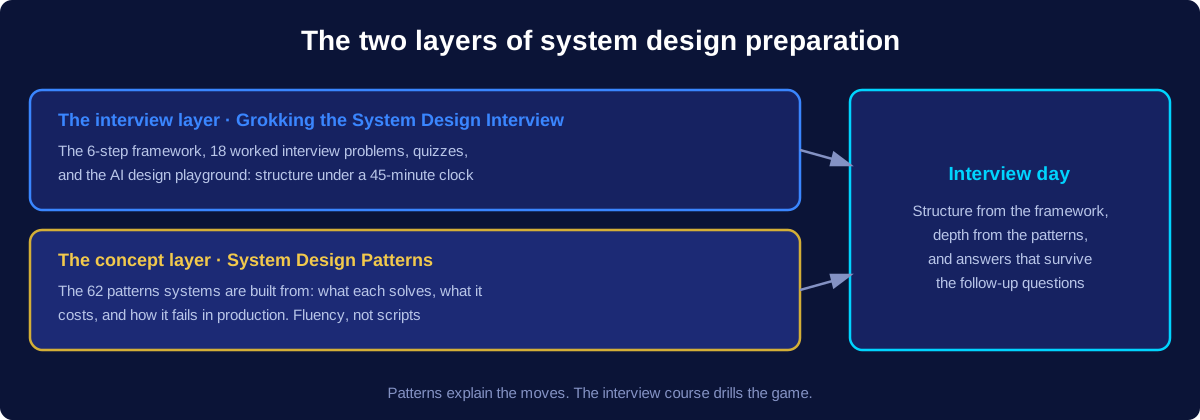
Grokking the System Design Interview is the interview layer. It teaches you to run a 45-minute design conversation: the 6-step framework, 18 classic problems worked end to end, ~400 quizzes, and the AI design playground for practicing attempts. It's built around a clock and an interviewer.
System Design Patterns is the concept layer. It teaches the 62 patterns systems are actually built from, one lesson each: what the pattern solves, what it costs, how it fails in production. No clock, no interviewer, just fluency. (Full tour of the course here.)
The interview course teaches you to structure an answer. The patterns course is why your answer survives the third follow-up question. Different layers, which is why the combination works and why, depending on your situation, one alone is often enough.
Where they overlap, honestly
There is real overlap, and pretending otherwise would be silly. Both courses cover the core building blocks: load balancing, caching, sharding, replication, queues. If you took the interview course, the patterns course's chapters on those topics will start on familiar ground.
The difference is depth, angle, and coverage:
- Depth: the interview course teaches cache-aside well enough to use it in a design answer. The patterns course teaches all five caching strategies plus stampede prevention, with the production failure stories.
- Angle: the interview course organizes by problem ("design Instagram"). The patterns course organizes by pattern, then proves the patterns with capstone designs.
- Coverage: roughly half the patterns course has no equivalent in the interview course at all: the coordination chapter (saga, quorum, vector clocks), operations (canary deploys, feature flags, tracing), data processing (streams, CDC, exactly-once, backpressure), and the entire AI infrastructure chapter (RAG, LLM gateways, semantic caching).
Call it 30% shared foundations, 70% distinct purpose. Enough overlap that beginners shouldn't run both simultaneously; enough difference that they don't substitute for each other.
Which first? Start from your situation
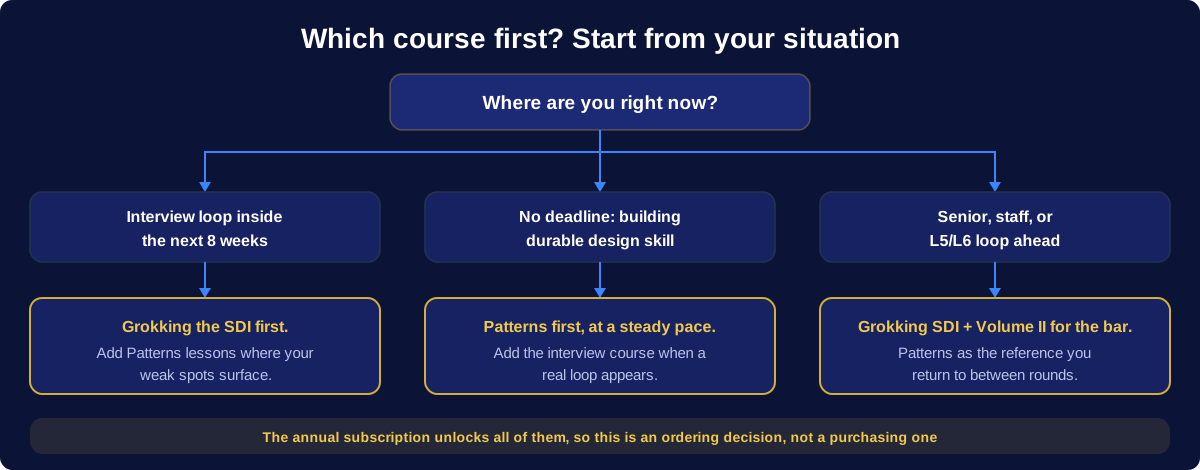
You have an interview loop inside the next 8 weeks
Grokking the System Design Interview, full stop. Deadline prep is about the framework, worked problems, and practice reps; that's the interview course's entire design. Use the patterns course surgically if feedback exposes a weak spot: bombed the caching follow-ups, go read the caching chapter. Don't attempt both end to end in a compressed window; the overlap will cost you practice time, and practice time decides interviews. The 2-week and 6-week study plans stay unchanged by the new course.
You have no deadline and want durable skill
Patterns first. Without a clock, the concept layer is the better foundation: it's organized for understanding rather than for interview coverage, it applies to your day job immediately, and its capstones build the design instinct gently. When a real loop appears, the interview course then goes fast, because you'll be learning a framework rather than concepts and a framework at once.
You're heading into senior, staff, or L5/L6 loops
The interview course plus Volume II remain the spine, because senior loops test structured depth under pressure, and Vol II's real-system deep dives target exactly that bar. The patterns course plays reference: the coordination, operations, and AI infrastructure chapters cover follow-up territory (sagas, canary rollouts, RAG architectures) that increasingly appears in senior rounds, and it's the material you'll want between interview cycles anyway.
You're a data or AI engineer
Patterns first, and possibly patterns only. The data processing and AI infrastructure chapters were built for your actual work, and general system design interviews may not even be your interview format. Add the interview course only when a system-design round is actually on your calendar.
The one-table version
| Your situation | Take first | Then |
|---|---|---|
| Interview inside 8 weeks | Grokking the SDI | Patterns chapters for weak spots only |
| No deadline, building skill | System Design Patterns | Interview course when a loop appears |
| Senior / staff / L5-L6 loop | Grokking the SDI + Volume II | Patterns as between-rounds reference |
| Data or AI engineer | System Design Patterns | Interview course only if the round exists |
| Total beginner to backend | Fundamentals | Then either, per the rows above |
So do you need both?
The genuinely honest answer, by group:
Need both: engineers who interview periodically and work on systems in between. The interview course for the loops, the patterns course for the years between them. This is most mid-level and senior backend engineers over a long enough horizon, and it's who the annual subscription (which includes both, plus Volume II and Fundamentals) exists for. If you're on the subscription, "do I need both" dissolves into "which order," answered above.
Need only the interview course: candidates with one loop ahead and no particular interest in going deeper afterward. That's a legitimate way to use these courses, and the interview course was built to be sufficient for it.
Need only the patterns course: working engineers who aren't interviewing and want the vocabulary and judgment for design reviews, incident calls, and architecture work. No interview course required to get full value.
Need neither yet: if you're still shaky on what a database index or an API actually is, start with Fundamentals; both of these courses will land far better afterward.
Frequently asked questions
Is System Design Patterns included with Grokking the System Design Interview? They're separate courses. The annual Design Gurus subscription unlocks both (along with Volume II and Fundamentals); lifetime access is per course.
How much do the two courses overlap? The core building blocks (caching, sharding, load balancing, queues) appear in both, at different depths and angles. Roughly 70% of the patterns course, including coordination, operations, data processing, and AI infrastructure, has no equivalent in the interview course.
Can System Design Patterns replace Grokking the System Design Interview for interview prep? Not on a deadline. It builds the depth that makes answers survive follow-ups, but it deliberately has no interview framework, no worked interview problems, and no time-boxed practice. For an actual loop, the interview course is the tool; the patterns course is the multiplier.
Which course should a beginner take first? A beginner with basic backend literacy and no interview date: patterns first. A beginner with an interview scheduled: the interview course. Completely new to backend concepts: Fundamentals before either.
Do the AI infrastructure patterns show up in interviews? Increasingly, at AI-heavy companies: RAG pipelines, model serving, and semantic caching have started appearing in loops. They're covered in the patterns course and summarized free in the pattern reference.
Related reading
- System Design Patterns: What the New Course Covers and Who It's For. The full tour of the concept-layer course.
- About Grokking the System Design Interview. The interview-layer course, explained.
- The 12 System Design Patterns That Decide Most Interviews. Where the two layers meet in practice.
- How Long Does It Take to Finish Grokking the System Design Interview?. The study plans the ordering advice plugs into.
Try both free tiers, in the right order
Both courses have free preview lessons on DesignGurus.io. Pick your row from the table above, start with that course's free tier, and you'll know within an hour whether the layer you chose is the layer you were missing.
Grokking the System Design Interview · System Design Patterns