
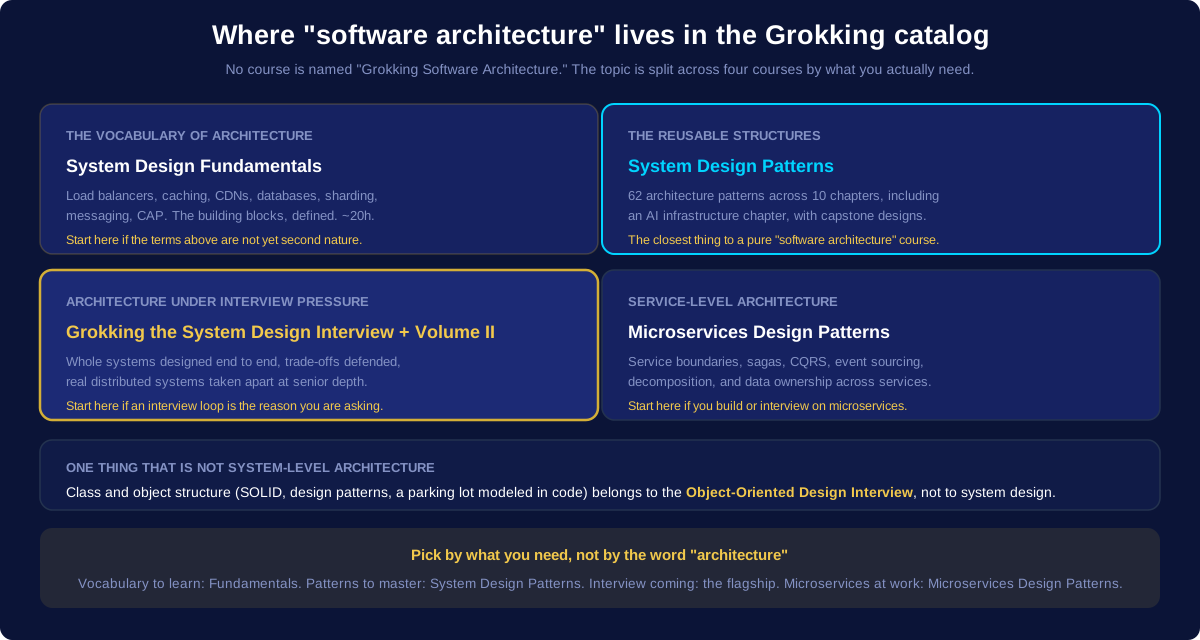
TL;DR: there is no course named "Grokking Software Architecture," so if you searched for one, here is the honest answer. Software architecture is split across four courses by what you need it for: System Design Fundamentals for the vocabulary, System Design Patterns for the reusable structures, Grokking the System Design Interview for architecture under interview pressure, and Microservices Design Patterns for service-level architecture. The table near the end matches your goal to one of them.
People search for "grokking software architecture" expecting a single course by that name. There isn't one, and pretending otherwise would waste your time. But the search makes sense: "software architecture" is a real skill, and the Grokking catalog does teach it, just under names that describe the job rather than the label. This page maps the topic to the courses that actually cover it, so you can pick one and stop searching.
Why there is no single "software architecture" course
"Software architecture" is an umbrella term. Ask ten engineers what it means and you get answers ranging from "how load balancers and databases fit together" to "how I split a monolith into services" to "the SOLID principles I use when I write a class." Those are genuinely different skills taught in different ways, so bundling them into one course would produce something too shallow to be useful for any of them.
The Grokking catalog splits the topic along the lines engineers actually hit in practice. The trick is knowing which slice you need.
The vocabulary: System Design Fundamentals
If "software architecture" to you means understanding what the pieces are, load balancers, caches, CDNs, databases, sharding, replication, message queues, and how they connect, that is System Design Fundamentals. It is roughly 100 short, text-based lessons with section quizzes and no prerequisites beyond basic programming, about 20 hours in total. It teaches the building blocks so that later, when a course or an interviewer says "put a cache in front of it," you already know what that means and why.
If you can already explain what a load balancer and a CDN do without looking them up, you can skip this one. The 30-second self-test here settles it.
The reusable structures: System Design Patterns
If "software architecture" to you means the patterns, the named, reusable structures you assemble systems out of, then System Design Patterns: From Fundamentals to Real Systems is the closest thing in the catalog to a pure software architecture course. It covers 62 architecture patterns across 10 chapters, including the catalog's only AI infrastructure chapter, with a capstone design at the end of each chapter and four full systems built at the end.
It is the one course in the catalog built for every engineer who works on systems, whether or not an interview is coming. The free one-page pattern reference lists all 62 so you can see the scope before enrolling.
Architecture under interview pressure: the flagship and Volume II
If you are asking because a system design interview is coming, then what you need is not architecture in the abstract but architecture you can defend out loud in 45 minutes. That is Grokking the System Design Interview: the 6-step framework, the building blocks at interview depth, a full trade-offs module, and 15 classic systems designed end to end across 83 lessons, with video, interactive diagrams, quizzes, and an AI design playground.
For Senior, Staff, and L5/L6 loops, Advanced System Design Interview, Volume II goes deeper: 142 lessons taking apart seven real distributed systems (Dynamo, Cassandra, Kafka, Chubby, GFS, HDFS, BigTable), twelve senior-level design problems, and mock-interview walkthroughs. This is architecture at the level where interviewers push on every trade-off.
Service-level architecture: Microservices Design Patterns
If "software architecture" to you means the shape of a distributed application, where the service boundaries go, how the pieces talk, how data is owned, then Grokking Microservices Design Patterns is the specialist course. It covers sagas, CQRS, event sourcing, decomposition strategies, and data ownership across services, for engineers building or interviewing on microservices specifically. How it differs from the other pattern courses is untangled here.
One thing that is not system-level architecture
A lot of people who type "software architecture" actually want the level below it: how to structure classes and objects, apply SOLID, and model something like a parking lot or an elevator in code. That is low-level or object-oriented design, and it lives in Grokking the Object Oriented Design Interview, not in any of the system design courses above. If you are not sure which level you need, the difference between high-level and low-level design is explained here.
Which course, by what you actually need
| What you mean by "software architecture" | The course | Why |
|---|---|---|
| The building blocks and the vocabulary | System Design Fundamentals | Teaches load balancers, caching, databases, messaging from zero |
| The reusable patterns you assemble systems from | System Design Patterns | 62 architecture patterns, interviews or not |
| Passing a system design interview | Grokking the System Design Interview | Framework plus 15 systems designed end to end |
| A senior / Staff / L5-L6 interview | Grokking the SDI + Volume II | Real distributed systems at senior depth |
| Designing microservices at work | Microservices Design Patterns | Service boundaries, sagas, CQRS, data ownership |
| Structuring classes and objects (SOLID) | Grokking the OOD Interview | Low-level design, a separate skill from system design |
On pricing: every course offers lifetime access individually, and the annual subscription unlocks the whole catalog, which is the sensible choice if you expect to cross more than one of these in a year. Most courses have free preview lessons, so you can open the one your row points to and confirm the fit before paying.
Frequently asked questions
Is there a course called Grokking Software Architecture? No. "Software architecture" is covered across several Design Gurus courses rather than a single one, because it means different things at different levels. This page maps each meaning to the course that covers it.
Which course is closest to a general software architecture course? System Design Patterns. It teaches 62 reusable architecture patterns for engineers who work on systems whether or not an interview is coming, which is the broadest, most architecture-centric course in the catalog.
I just want to pass an interview. Which one? Grokking the System Design Interview for most loops, and add Volume II if you are targeting Senior, Staff, or L5/L6. Skip the pure-architecture framing; interview prep is the faster path when a date is on the calendar.
Is software architecture the same as system design? Overlapping, not identical. System design is architecture aimed at whole systems and their trade-offs. Object-oriented design is architecture aimed at classes and objects. The Grokking catalog keeps them in separate courses on purpose.
Do I need more than one of these? Usually not at the same time. Pick the one row in the table above that matches your goal and finish it before adding another. The subscription exists for people who will genuinely cross several over a year.
Related reading
- Every Grokking Course, Explained. The full, current catalog map.
- System Design Patterns: the complete reference. The closest thing to a software architecture course, in detail.
- System Design vs Object-Oriented Design Interviews. High-level vs low-level, and which prep you need.
- Grokking's Pattern Courses, Untangled. The three "patterns" courses disambiguated.
Pick by the need, not the word
"Software architecture" is a search term, not a course. Decide which of the six meanings in the table is yours, open that one course's free preview on DesignGurus.io, and let the rest go.
Browse All Courses on DesignGurus.io · Start with System Design Patterns, Free Preview